Manuals

fanuc robot programming manual pdf

Fanuc Robot Programming Manual PDF: A Comprehensive Guide

ROBOGUIDE V10‚ the latest iteration‚ delivers advanced offline programming and simulation capabilities. It boasts enhanced performance and a significantly improved user experience for
programmers.

Fanuc robot programming is a cornerstone of modern industrial automation‚ enabling precise control and repeatable performance across diverse applications. Mastering this skill requires a solid understanding of the available programming languages‚ control systems‚ and software tools. A Fanuc robot programming manual PDF serves as an invaluable resource for both novice and experienced programmers‚ providing detailed guidance on everything from basic operations to advanced techniques.

These manuals cover essential aspects like robot kinematics‚ motion commands‚ I/O configuration‚ and safety protocols. They often include practical examples and troubleshooting tips‚ accelerating the learning process and minimizing downtime. The latest versions‚ such as those supporting ROBOGUIDE V10‚ emphasize offline programming and simulation‚ allowing users to develop and test programs without interrupting production. Accessing a comprehensive Fanuc robot programming manual PDF is the first step towards unlocking the full potential of these powerful robotic systems‚ ensuring efficient and reliable operation.

Understanding Fanuc Robot Control Systems

Fanuc robot control systems are renowned for their reliability and precision‚ forming the brain of any automated process. A thorough understanding of these systems is crucial for effective programming and maintenance. The Fanuc robot programming manual PDF provides detailed insights into the architecture‚ components‚ and functionalities of these controllers‚ including the various hardware and software interfaces.

These manuals explain the role of the motion controller‚ servo amplifiers‚ and I/O modules‚ detailing how they interact to execute programmed instructions. They also cover the system’s safety features and emergency stop mechanisms. With the advent of tools like ROBOGUIDE V10‚ understanding the control system’s integration with simulation software is paramount. A well-documented Fanuc robot programming manual PDF empowers users to diagnose issues‚ optimize performance‚ and ensure seamless operation of the robotic cell‚ maximizing productivity and minimizing potential disruptions.

TP Programming (Teach Pendant Programming)

Teach Pendant Programming (TP) is a fundamental method for controlling Fanuc robots‚ allowing direct interaction and real-time adjustments. The Fanuc robot programming manual PDF dedicates significant sections to TP programming‚ detailing the interface‚ menu structure‚ and available commands. It explains how to jog the robot‚ record positions‚ and create basic programs directly through the teach pendant.

These manuals emphasize the importance of understanding coordinate systems and frame definitions within the TP environment. They also cover advanced TP features like interrupt handling and background processing. Utilizing ROBOGUIDE V10 alongside the Fanuc robot programming manual PDF allows users to simulate and validate TP programs offline‚ reducing downtime and improving program accuracy. Mastering TP programming‚ guided by comprehensive documentation‚ is essential for quick prototyping‚ troubleshooting‚ and making on-the-fly adjustments in a production environment‚ ensuring efficient robot operation.

KAREL Programming: An Overview

KAREL is a high-level programming language specifically designed for Fanuc robots‚ offering greater flexibility and complexity than TP programming. The Fanuc robot programming manual PDF provides extensive documentation on KAREL syntax‚ data types‚ and program structure. It details how to create custom functions‚ manage variables‚ and implement advanced logic within robotic applications.

KAREL excels in tasks requiring complex decision-making‚ data manipulation‚ and communication with external devices. The manuals explain how to integrate KAREL programs with TP programs‚ leveraging the strengths of both methods. ROBOGUIDE V10 supports KAREL programming‚ enabling simulation and debugging of KAREL code before deployment. Understanding KAREL‚ as outlined in the Fanuc robot programming manual PDF‚ unlocks the potential for creating highly customized and efficient robotic solutions‚ exceeding the capabilities of basic teach pendant programming and streamlining complex automation processes.

Fanuc ROBOGUIDE: Simulation and Offline Programming

Fanuc ROBOGUIDE is a powerful software suite for creating‚ simulating‚ and debugging robot programs offline. The Fanuc robot programming manual PDF often references ROBOGUIDE as a crucial tool for program development and validation. It allows users to build virtual robot cells‚ import CAD data‚ and test programs without interrupting production. This significantly reduces downtime and optimizes cycle times.

ROBOGUIDE V10‚ the latest version‚ features enhanced performance and a more intuitive user interface‚ as detailed in associated documentation. The Fanuc robot programming manual PDF explains how to transfer programs created in ROBOGUIDE to the actual robot controller. Simulation capabilities include collision detection‚ reachability analysis‚ and cycle time estimation. Mastering ROBOGUIDE‚ guided by the manual‚ is essential for efficient robot deployment and troubleshooting‚ minimizing risks and maximizing productivity in automated processes.

ROBOGUIDE V10 Features and Benefits

ROBOGUIDE V10 represents a significant advancement in offline robot programming‚ as highlighted within the Fanuc robot programming manual PDF. Key features include improved performance‚ enabling faster simulation speeds and handling of more complex robot cells. The user interface has been redesigned for enhanced intuitiveness‚ streamlining the programming process.

Benefits extend to reduced commissioning times‚ as programs are thoroughly tested and validated offline before deployment. Collision detection is more robust‚ preventing potential damage and ensuring safety. The Fanuc robot programming manual PDF details how to leverage these features for optimized cycle times and increased throughput. Furthermore‚ ROBOGUIDE V10 supports a wider range of Fanuc robot models and controllers‚ offering greater flexibility. It’s a vital tool for minimizing downtime‚ improving robot utilization‚ and accelerating automation projects‚ all documented within the comprehensive manual.

Downloading Fanuc Robot Programming Manuals (PDF)

Accessing the Fanuc robot programming manual PDF is crucial for effective robot operation and maintenance. Official manuals are typically available through the Fanuc America Corporation website‚ requiring registration and often a valid serial number for your specific robot controller. Several online resources and forums dedicated to industrial automation may also host archived versions‚ but verifying their authenticity is paramount.

Be cautious of unofficial sources‚ as outdated or inaccurate manuals can lead to programming errors or safety hazards. The Fanuc robot programming manual PDF contains vital information on safety protocols‚ troubleshooting guides‚ and detailed programming instructions. Always prioritize downloading from the official Fanuc website to ensure you have the most current and reliable documentation. Remember to regularly check for updates‚ as Fanuc frequently releases revised manuals reflecting software and hardware changes. Proper documentation is key to maximizing your investment in Fanuc robotics.

Common Fanuc Robot Programming Languages

Fanuc robot programming primarily revolves around two core languages: TP (Teach Pendant) programming and KAREL. TP programming‚ utilizing the teach pendant‚ is ideal for straightforward tasks and quick adjustments‚ offering a user-friendly interface for direct robot control. KAREL‚ a proprietary language resembling Pascal‚ provides greater flexibility and power for complex applications‚ allowing for advanced logic‚ data handling‚ and communication with external devices.

The Fanuc robot programming manual PDF details both languages extensively. While TP is excellent for initial setup and basic movements‚ KAREL excels in creating sophisticated routines for palletizing‚ welding‚ or complex assembly processes. Understanding both is beneficial‚ as they are often used in conjunction. Newer systems also support integration with external programming environments like .NET and Python‚ expanding programming possibilities. Mastering these languages‚ guided by the official documentation‚ unlocks the full potential of Fanuc robots.

Motion Commands and Instructions

Fanuc robot programming relies on a robust set of motion commands detailed within the Fanuc robot programming manual PDF. These commands govern the robot’s movements‚ encompassing point-to-point (PTP)‚ linear (LIN)‚ circular (CIRC)‚ and spline interpolation. PTP moves the robot directly to a specified point‚ prioritizing speed. LIN creates straight-line paths‚ crucial for precise applications. CIRC enables arc and circular movements‚ essential for welding and material handling.

The manual thoroughly explains parameters like speed‚ acceleration‚ and blending‚ allowing programmers to fine-tune motion profiles. Instructions like ‘MOVE’ initiate movement‚ while ‘SPEED’ and ‘ACCEL’ control the robot’s dynamics. Mastering these commands‚ alongside understanding coordinate systems (joint‚ world‚ tool)‚ is fundamental. Advanced features include motion synchronization and path following‚ enabling complex‚ coordinated movements. Proper utilization of these commands‚ as outlined in the documentation‚ ensures efficient and accurate robot operation.

Input/Output (I/O) Configuration and Programming

The Fanuc robot programming manual PDF dedicates significant coverage to Input/Output (I/O) configuration‚ a critical aspect of robotic system integration; I/O allows the robot to interact with external devices – sensors‚ actuators‚ PLCs‚ and more. The manual details how to define and assign digital and analog I/O signals within the robot controller. This involves configuring I/O boards and mapping signals to specific addresses.

Programming I/O utilizes instructions like ‘INPUT’ and ‘OUTPUT’ to read sensor data and control external devices. The manual explains how to use these instructions within TP and KAREL programs; Proper I/O programming ensures seamless communication between the robot and its environment. Considerations include signal timing‚ synchronization‚ and error handling. Understanding I/O configuration is vital for building automated systems that respond intelligently to real-world conditions‚ as thoroughly documented in the provided resources.

Palletizing Applications Programming

The Fanuc robot programming manual PDF provides detailed guidance on programming palletizing applications‚ a common use case for industrial robots. It outlines strategies for defining pallet patterns‚ layer configurations‚ and pick-up/placement sequences. The manual emphasizes utilizing motion commands – like linear and circular interpolation – to achieve efficient and accurate palletizing.

Programming often involves defining work objects representing boxes‚ layers‚ and pallets. The manual explains how to use user frames and tool frames to simplify coordinate transformations. Key considerations include collision avoidance‚ cycle time optimization‚ and handling variations in product dimensions. Furthermore‚ the PDF details how to integrate vision systems for dynamic palletizing‚ where the robot adapts to changing product positions. Mastering these techniques‚ as described in the manual‚ enables the creation of robust and flexible palletizing solutions.

Welding Applications Programming

The Fanuc robot programming manual PDF dedicates significant sections to welding applications‚ detailing the intricacies of arc welding robot programs. It covers essential aspects like setting weld parameters – voltage‚ current‚ wire feed speed – and configuring welding tools. The manual explains how to utilize specialized welding instructions within the Fanuc programming language‚ enabling precise control over the welding process.

Programming for welding often involves defining weld paths‚ maintaining consistent torch angles‚ and managing weld sequences. The PDF emphasizes the importance of using search functions to locate weld joints accurately‚ even with part variations. It also details techniques for weave patterns and seam tracking. Furthermore‚ the manual provides guidance on integrating external welding power sources and sensors. Understanding these concepts‚ as outlined in the manual‚ is crucial for developing efficient and high-quality robotic welding cells.

Error Handling and Troubleshooting

The Fanuc robot programming manual PDF provides a comprehensive section dedicated to error handling and troubleshooting‚ a critical aspect of robotic system maintenance. It details common error codes‚ their potential causes‚ and recommended corrective actions. This section isn’t just a list of codes; it explains the underlying logic that triggers them‚ aiding in effective diagnosis.

The manual emphasizes a systematic approach to troubleshooting‚ starting with verifying basic connections and power supplies. It guides users through interpreting alarm messages displayed on the teach pendant and utilizing diagnostic tools within the robot controller. Furthermore‚ it covers procedures for recovering from program crashes and handling communication errors. Understanding the manual’s guidance on error recovery minimizes downtime and ensures the continued operation of the robotic system. It also stresses safety precautions when addressing error conditions‚ preventing potential hazards during maintenance.

Safety Considerations in Fanuc Robot Programming

The Fanuc robot programming manual PDF dedicates significant attention to safety‚ recognizing the inherent risks associated with robotic systems. It outlines crucial safety standards and guidelines that programmers must adhere to during program development and execution. This includes detailed explanations of safety functions like emergency stops‚ safety-rated monitored stops‚ and speed and separation monitoring.

The manual stresses the importance of risk assessments before implementing any robotic application. It provides guidance on defining work envelopes‚ establishing safety zones‚ and implementing appropriate safeguarding measures‚ such as light curtains and safety scanners. Programmers are instructed on how to utilize safety features within the robot controller and how to properly configure safety parameters. Furthermore‚ the manual emphasizes the need for thorough testing and validation of safety functions before deploying a program in a production environment. Ignoring these safety considerations can lead to serious injury or damage.

Resources for Fanuc Robot Programming Support

Accessing comprehensive support is vital when working with Fanuc robot programming. Beyond the detailed Fanuc robot programming manual PDF‚ a wealth of resources exists for programmers of all levels. Fanuc America’s website provides a dedicated support section‚ including frequently asked questions (FAQs)‚ application examples‚ and technical bulletins.

Fanuc also offers extensive training programs‚ ranging from introductory courses to advanced certification programs‚ covering TP programming‚ KAREL‚ and ROBOGUIDE. These courses‚ often delivered both online and in-person‚ provide hands-on experience and expert guidance. Furthermore‚ a global network of authorized Fanuc integrators offers specialized support and custom programming services. Online forums and communities dedicated to Fanuc robotics provide a platform for users to share knowledge‚ troubleshoot issues‚ and collaborate on projects. Utilizing these resources ensures efficient problem-solving and maximizes the potential of Fanuc robotic systems.

Latest Updates and Future Trends in Fanuc Robotics

Fanuc consistently pushes the boundaries of robotics‚ with recent updates focusing on enhanced integration and intelligent features. ROBOGUIDE V10‚ highlighted in the latest Fanuc robot programming manual PDF updates‚ exemplifies this commitment‚ offering significant performance improvements and a streamlined user interface. Future trends point towards increased adoption of AI and machine learning within robot control systems.

Expect to see more sophisticated motion planning algorithms‚ predictive maintenance capabilities‚ and collaborative robots (cobots) with advanced sensing and safety features. Cloud-based robot programming and remote monitoring are also gaining traction‚ enabling greater flexibility and accessibility. Fanuc is actively developing solutions for digital twin technology‚ allowing for virtual commissioning and optimization of robotic cells. These advancements‚ detailed in evolving documentation‚ will empower users to achieve higher levels of automation and efficiency in their operations‚ demanding continuous learning and adaptation.

Manuals

westclox alarm clock manual

Westclox Alarm Clock Manual: A Comprehensive Guide

Navigating the world of Westclox alarm clocks requires a detailed manual, especially for vintage models like the Bold II Dialite 22192.
This guide offers restoration, repair, and setting instructions, alongside valuable resources for collectors seeking parts and valuation information.

Westclox alarm clocks represent a significant piece of American history, renowned for their durability, distinctive designs, and reliable timekeeping. For generations, these clocks have awakened households, becoming a staple on bedside tables across the nation. Understanding these timepieces requires delving into their mechanics and appreciating their evolution.

This manual aims to provide a comprehensive overview, catering to both casual users and dedicated collectors. Whether you’ve recently acquired a vintage Westclox or inherited a family heirloom, this guide will equip you with the knowledge to properly operate, maintain, and even restore these iconic clocks.

Many users, particularly with models like the Dialite Electric Alarm Clock (Model 22192), encounter difficulties setting the time and alarm. Online forums, such as Reddit’s r/clocks, frequently host discussions seeking guidance on these specific challenges. This manual addresses these common issues, offering step-by-step instructions and troubleshooting tips.

Historical Overview of Westclox

Westclox’s story began in 1886 as the Western Clock Manufacturing Company, initially producing affordable clocks for the American market. Their early success stemmed from innovative manufacturing techniques and a commitment to quality. By the 1920s, Westclox had become synonymous with reliable alarm clocks, particularly those manufactured between 1920 and 1949 – a period highly sought after by collectors today.

The company’s ability to adapt to changing technologies, like the introduction of electric clocks such as the Dialite models, cemented their position as an industry leader. These electric clocks, often featuring illumination, offered a modern alternative to traditional mechanical movements.

Throughout the 20th century, Westclox continued to innovate, producing a diverse range of clocks, including radio clocks and novelty designs. Today, vintage Westclox clocks are prized for their historical significance, aesthetic appeal, and enduring functionality, driving a robust market for both clocks and replacement parts on platforms like eBay.

Popular Westclox Models (1920-1949)

The period between 1920 and 1949 represents a golden age for Westclox, yielding numerous iconic models now highly valued by collectors. The Big Ben, with its robust mechanical movement and distinctive bell, remains a classic. Similarly, the Seven Jewels model, known for its reliability and elegant design, is frequently sought after.

As electrification gained traction, Westclox introduced models like the Dialite, offering illuminated dials for easy nighttime reading. The Bold II Dialite, specifically model 22192, exemplifies this era, often presenting challenges in setting the time and alarm due to its unique mechanism.

Other notable models include various iterations of the Scott and the Farm Alarm, each catering to different consumer preferences. These clocks, readily available on platforms like eBay, showcase Westclox’s commitment to both functionality and aesthetic appeal, solidifying their place in American horological history.

Understanding Westclox Clock Mechanisms

Westclox alarm clocks, particularly those from the 1920-1949 period, primarily utilize mechanical movements powered by a mainspring. These movements rely on a series of gears, levers, and escapements to accurately measure and display time. The key components include the balance wheel, which regulates timekeeping, and the escapement, which releases the mainspring’s energy in controlled increments.

Later models, like the Dialite 22192, incorporated electric motors to drive the hands, simplifying the winding process. However, these electric movements still often retained mechanical alarm mechanisms. Understanding the interplay between these components is crucial for troubleshooting and repair.

The alarm function is typically activated by a separate spring and cam system, designed to trigger the alarm bell at a pre-set time. Recognizing these fundamental principles allows for a more informed approach to Westclox clock maintenance and restoration.

Types of Westclox Movements

Westclox employed a variety of movements throughout its history, catering to different price points and functionalities. Early models predominantly featured key-wound, mechanical movements, requiring daily winding to maintain operation. These movements, while robust, demanded regular cleaning and lubrication.

The introduction of electric alarm clocks in the mid-20th century brought about a shift towards synchronous movements, powered by the alternating current from a wall outlet. These movements eliminated the need for winding, offering increased convenience.

Dialite models, such as the 22192, utilized a unique combination of electric and mechanical components. The electric motor drove the timekeeping, while a separate mechanical mechanism controlled the alarm function. Identifying the specific movement type is essential for accurate repair and sourcing appropriate replacement parts.

Dialite Electric Alarm Clock Mechanisms (e.g., Model 22192)

The Dialite electric alarm clock, exemplified by the Model 22192, represents a fascinating blend of technologies. These clocks utilize a synchronous electric motor to power the timekeeping, offering silent and reliable operation. However, the alarm function remains entirely mechanical, driven by a separate spring-wound mechanism.

This dual system means the clock needs to be plugged in for accurate time, but the alarm will still function even during a power outage. The illumination feature, a hallmark of Dialite models, is achieved through a small light bulb positioned behind the dial, activated when plugged in.

Understanding this hybrid design is crucial for troubleshooting. Issues with timekeeping often point to the electric motor, while alarm problems relate to the mechanical components; The seconds hand movement, often a point of confusion, is directly linked to the electric motor’s operation.

Setting the Time on Vintage Westclox Clocks

Setting the time on a vintage Westclox clock varies significantly by model, but generally involves manipulating the hour and minute hands directly. For many mechanical models, gently rotate the hands clockwise until the correct time is displayed – avoid forcing them backwards, as this can damage the delicate gears.

Dialite electric clocks, like the Model 22192, present a unique challenge. Initially, ensure the clock is plugged in; the seconds hand should begin moving, indicating the motor is engaged. Then, carefully turn the hour and minute hands to the desired time. The hands are typically adjusted by rotating them forward.

If the hands are difficult to move, or the clock doesn’t keep accurate time after setting, a cleaning and lubrication may be necessary. Remember to always handle vintage clocks with care to preserve their functionality and value.

Setting the Alarm on Vintage Westclox Clocks

Activating the alarm on a vintage Westclox clock often involves a separate alarm hand and a dedicated alarm setting mechanism. Locate the smaller alarm hand, typically red, and rotate it to the desired alarm time. This is usually done independently of the main time-telling hands.

For models like the Bold II Dialite (22192), the alarm is set by positioning the red alarm hand over the time you wish the alarm to sound. Ensure the alarm hand doesn’t overlap with the main hour or minute hands, as this can prevent the alarm from functioning correctly.

A small lever or button usually engages the alarm. Once set, test the alarm to confirm it rings at the correct time and with sufficient volume. If the alarm doesn’t function, inspect the alarm bell and its associated mechanism for obstructions or damage. Careful adjustment is key!

Troubleshooting Common Westclox Issues

Many Westclox issues stem from age and accumulated dust. A common problem is a clock that fails to run; gently cleaning the movement with appropriate clock oil can often resolve this. If the clock runs but loses time, the regulator arm may need adjustment – a delicate process requiring patience.

For Dialite models like the 22192, a frequently reported issue is a seconds hand that moves independently of the hour and minute hands. This indicates a disconnection or slippage within the gear train. Inspect for broken teeth or dislodged components.

Alarm malfunctions are also typical. Check the alarm bell for obstructions and ensure the alarm hand is correctly positioned. If illumination fails in Dialite models, examine the bulb and wiring for breaks. Remember safety first – disconnect power before any internal inspection!

Seconds Hand Movement Problems (Model 22192 Specific)

The Westclox 22192’s seconds hand issue is a well-documented frustration for owners. Often, the hand spins continuously while the hour and minute hands remain stationary, indicating a disconnection between the main gear train and the seconds mechanism. This isn’t necessarily a fatal flaw, but requires careful attention.

Inspect the small pinion gear that drives the seconds hand; it may be loose on its shaft or stripped. Gently attempt to reseat it, but avoid excessive force. A common cause is dried, hardened grease impeding the gear’s movement. Cleaning with a suitable solvent and re-lubricating can sometimes restore function.

If the pinion appears intact, examine the connection to the center wheel. A broken or bent lever can also cause this symptom. Online forums, like r/clocks, frequently discuss this specific problem, offering detailed repair advice and potential parts sources.

Illumination Issues in Dialite Models

Dialite Westclox clocks, like the Model 22192, utilize a unique illumination system that can fail over time. The glow is produced by a radioactive material (radium or promethium) causing a phosphor coating to illuminate, but diminished brightness is a common complaint.

First, ensure the clock is properly plugged in, as the illumination relies on electrical current; If illuminated initially, but fades quickly, the phosphor is likely nearing the end of its lifespan – a natural degradation process. There’s no practical restoration for this.

However, a completely dark dial might indicate a broken or disconnected internal light bulb or a faulty wiring connection. Carefully inspect the bulb (if accessible) and wiring for damage. Caution: handling vintage clocks with radioactive materials requires awareness and responsible disposal of any components.

Westclox Clock Restoration and Repair

Restoring a Westclox clock is a rewarding endeavor, but requires patience and careful attention to detail. Begin by thoroughly cleaning the case – mild soap and water are usually sufficient, avoiding harsh chemicals. Disassembly should be approached cautiously, documenting each step with photos to aid reassembly.

Common repairs involve cleaning and lubricating the movement. Old, hardened grease hinders operation; specialized clock oil is essential. Inspect gears for wear or damage, replacing if necessary. Dial restoration, particularly for Dialite models, is complex and often best left to professionals due to the radioactive material.

Before undertaking any electrical repairs, ensure the clock is unplugged. Damaged wiring should be replaced with appropriate gauge wire. Remember, finding replacement parts can be challenging, but resources like eBay and specialized clock part suppliers exist. Prioritize preserving originality whenever possible.

Finding Replacement Parts for Westclox Clocks

Sourcing replacement parts for vintage Westclox clocks can be a significant challenge, but thankfully, several avenues exist for dedicated restorers. eBay is often the first port of call, boasting a constantly changing inventory of original parts, movements, and even complete clocks for scavenging. Be diligent in checking seller ratings and part descriptions.

Specialized clock parts suppliers cater specifically to antique clock repair. These businesses often stock a wider range of Westclox-specific components, including hands, dials, and movement parts. Online forums, like the Reddit r/clocks community, can also be invaluable for locating hard-to-find items, as members frequently trade or sell parts.

Consider joining Westclox collector groups; members often share resources and leads on parts availability. Patience is key, as finding the correct component may take time. Always verify compatibility before purchasing, referencing model numbers and part diagrams.

Westclox Price Guides and Valuation

Determining the value of a Westclox alarm clock requires considering several factors, including model rarity, condition, and originality. Comprehensive price guides dedicated solely to Westclox are somewhat scarce, making accurate valuation challenging. eBay’s completed listings offer a valuable real-time snapshot of current market prices for similar models.

However, relying solely on eBay can be misleading; condition significantly impacts value. Clocks in excellent, original condition command substantially higher prices than those with damage or replaced parts. Online appraisal services specializing in antique clocks can provide professional valuations, though these typically incur a fee.

Researching auction records from reputable antique auction houses can also offer insights into high-end valuations. Remember that desirability and collector demand influence prices, with certain models, like those from 1920-1949, being particularly sought after.

Online Resources for Westclox Collectors

The internet provides a wealth of resources for Westclox enthusiasts, fostering a vibrant community and facilitating access to information. Reddit’s r/clocks forum is a particularly active hub, offering a platform for asking questions, sharing knowledge, and troubleshooting issues – as evidenced by recent queries regarding setting the Bold II Dialite Model 22192.

eBay serves as a primary marketplace for both clocks and replacement parts, though careful examination of listings is crucial. Beyond these, dedicated Westclox collector websites, though less common, often contain detailed model information and historical context.

Furthermore, general antique clock forums frequently host Westclox-specific discussions. Social media groups dedicated to vintage clocks can also connect collectors. Utilizing these resources effectively requires discerning credible information and cross-referencing details to ensure accuracy, especially when attempting repairs or valuations.

Reddit r/clocks Forum for Westclox Support

The r/clocks subreddit is an invaluable resource for Westclox owners seeking assistance, particularly with vintage models. Recent posts demonstrate a common challenge: setting the time and alarm on clocks like the Bold II Dialite Electric Alarm Clock, Model 22192, where the seconds hand operates but other functions remain elusive.

This forum’s strength lies in its active community, comprised of experienced collectors and repair enthusiasts willing to share their expertise. Users frequently post detailed questions, accompanied by images, receiving tailored advice from knowledgeable members.

Searching the subreddit archives often reveals solutions to previously encountered problems. It’s a dynamic platform where troubleshooting tips, restoration techniques, and identification assistance are readily available. Remember to provide clear details and images when seeking help to maximize the quality of responses received from the community.

eBay for Westclox Clocks and Parts

eBay serves as a vast marketplace for Westclox alarm clocks and essential replacement parts, catering to both collectors and those undertaking restoration projects. A significant number of listings feature collectible models manufactured between 1920 and 1949, offering a diverse range of styles and conditions.

Searching for specific model numbers, like the 22192 Dialite, is crucial for locating compatible components. Beyond complete clocks, eBay frequently hosts auctions for dials, hands, movements, and even original manuals – invaluable resources for repair and accurate operation.

Careful examination of seller feedback and item descriptions is paramount. Pay attention to detailed photos and descriptions of functionality. Price guides and publications are also available, aiding in valuation and ensuring a fair purchase. eBay provides a convenient platform to source the necessary items to breathe new life into a vintage Westclox.

Dating Your Westclox Alarm Clock

Accurately dating your Westclox alarm clock is fundamental for collectors and restorers, influencing its value and guiding appropriate repair techniques. While some models display explicit manufacturing dates, many require a more investigative approach.

Identifying the model number is the first crucial step. Westclox utilized a numbering system that often correlates with production periods. Researching the model number online, using dedicated Westclox resources, can pinpoint the approximate year of manufacture.

Movement markings and dial styles also offer valuable clues. Early movements differ significantly from later iterations. Dial designs evolved over time, reflecting changing aesthetic preferences. Examining these details, alongside the overall case construction, helps narrow down the timeframe. Clocks manufactured between 1920-1949 are particularly sought after, requiring careful scrutiny to establish their age and authenticity.

Identifying Westclox Model Numbers

Locating the Westclox model number is paramount for research, repair, and valuation. These numbers, typically found on the clock’s movement, case back, or dial, unlock a wealth of information about its history and specifications.

The movement is the primary location for the model number. Accessing it often requires carefully removing the clock’s back cover. Look for a stamped or etched number, frequently a combination of digits. The model 22192, for example, identifies the Bold II Dialite Electric Alarm Clock.

Sometimes, the number appears on the dial itself, though this is less common. The case back may also contain markings, but these can be less reliable. Online Westclox databases and collector forums are invaluable resources for deciphering these numbers and understanding their significance. Knowing the model number allows access to specific manuals, parts lists, and troubleshooting guides.

Westclox Clock Maintenance Tips

Regular maintenance ensures the longevity and accuracy of your Westclox alarm clock. Dust accumulation is a common issue; gently clean the exterior with a soft, dry cloth. Avoid abrasive cleaners or liquids, especially near the dial and any electrical components.

For mechanical movements, occasional oiling is crucial. However, this is best left to experienced clock repairers, as improper lubrication can cause more harm than good. Inspect the cord and plug of electric models like the Dialite 22192 for any signs of damage, and never operate a clock with a frayed cord.

Avoid placing clocks in direct sunlight or humid environments. These conditions can damage the finish and affect the movement’s accuracy. Periodically check the tightness of screws and other fasteners. Proper care will preserve your Westclox clock for generations.

Manuals

2012 ram 1500 owners manual

The 2012 Ram 1500 owner’s manual is a vital resource, offering comprehensive guidance on operation, maintenance, and safety features for this powerful truck․

Overview of the Vehicle

The 2012 Ram 1500 represents a significant blend of capability, comfort, and technology within the full-size pickup truck segment․ This vehicle caters to a diverse range of needs, from daily commuting and family transport to demanding work tasks and recreational pursuits․ Understanding its features, as detailed in the owner’s manual, is crucial for maximizing its potential․

Available in numerous configurations – including various cab sizes, bed lengths, and trim levels – the Ram 1500 offers considerable customization․ The manual thoroughly explains these options, helping owners identify their specific vehicle’s characteristics․ It also details the truck’s core components, from the robust frame and suspension to the powerful engine choices and advanced safety systems․ Familiarizing yourself with these aspects ensures safe and efficient operation․

Importance of the Owner’s Manual

Your 2012 Ram 1500 owner’s manual is far more than just a collection of pages; it’s a comprehensive guide to understanding and maintaining your vehicle․ It contains vital information regarding operation, safety features, and scheduled maintenance, all tailored specifically to your truck․ Ignoring this resource can lead to improper use, potential damage, and even safety hazards․

The manual details everything from basic controls and instrument panel functions to complex systems like the anti-lock brakes and airbag deployment․ It also outlines recommended service intervals for oil changes, tire rotations, and fluid checks, helping you preserve your Ram 1500’s reliability and value․ Regularly consulting the manual empowers you to be a proactive and informed owner, ensuring years of dependable performance․

Understanding Your Vehicle

Familiarizing yourself with the 2012 Ram 1500’s components and systems, as detailed in the owner’s manual, is crucial for safe and efficient operation․

Vehicle Identification Number (VIN) Location

Locating your 2012 Ram 1500’s Vehicle Identification Number (VIN) is essential for various reasons, including warranty claims, theft recovery, and obtaining vehicle history information․ The owner’s manual specifies several locations where you can find this unique 17-digit code․

Typically, the VIN is visible on a plate affixed to the driver’s side dashboard, easily viewed through the windshield․ It’s also often found on the driver’s side doorjamb sticker․ Additionally, the VIN is stamped on the frame of the vehicle, usually on the driver’s side, near the engine compartment․ Refer to your specific owner’s manual for the precise location for your vehicle configuration, as slight variations may exist․

Key Components and Systems

The 2012 Ram 1500 boasts a robust array of components and systems, all detailed within the owner’s manual for optimal understanding and maintenance․ Key areas covered include the powertrain – encompassing the engine and transmission – detailing their operation and recommended servicing․

The manual also provides in-depth information on the electrical system, including the battery, alternator, and wiring harnesses․ Furthermore, it outlines the functionality of the chassis, suspension, steering, and braking systems․ Understanding these core elements is crucial for safe operation and proactive maintenance, ensuring the longevity and reliability of your Ram 1500․ Detailed diagrams and explanations are provided throughout․

Engine Specifications

The 2012 Ram 1500 owner’s manual meticulously details the engine specifications for each available powertrain option․ This includes information on displacement, horsepower, torque, and compression ratio for the 3․7L V6, 4․7L V8, and the 5․7L HEMI V8 engines․

The manual also specifies recommended fuel types, oil capacities, and cooling system details․ Bore and stroke dimensions are provided, alongside information regarding valve train configuration․ Understanding these specifications is vital for proper maintenance, troubleshooting, and ensuring optimal engine performance․ Detailed charts and tables offer a clear and concise overview of each engine’s capabilities and requirements, aiding in informed vehicle care․

Transmission Details

The 2012 Ram 1500 owner’s manual provides comprehensive details regarding the available transmission options․ It covers both the standard six-speed manual transmission and the popular six-speed automatic transmission, outlining their respective gear ratios and operational characteristics․

Fluid type and capacity specifications are clearly stated, alongside recommended service intervals for fluid changes․ The manual details how the transmission operates, including shift patterns and any specific driving considerations․ Information on troubleshooting common transmission issues is also included․ Understanding these details is crucial for maintaining optimal performance and extending the life of your Ram 1500’s transmission system, ensuring smooth and reliable operation․

Braking System Information

The 2012 Ram 1500 owner’s manual dedicates a section to the vehicle’s braking system, detailing its components and operation․ It explains the functionality of the four-wheel anti-lock brake system (ABS), highlighting its role in maintaining control during emergency stops and on slippery surfaces․

The manual specifies brake fluid type and provides instructions for checking brake fluid levels․ It also outlines procedures for inspecting brake pads and rotors for wear, and emphasizes the importance of regular brake maintenance․ Information regarding the electronic brake force distribution system is included, alongside troubleshooting tips for common braking issues․ Proper understanding of this system ensures safe and reliable stopping power․

Operation and Maintenance

The 2012 Ram 1500 manual provides detailed instructions for safe vehicle operation and a comprehensive maintenance schedule to ensure longevity and performance․

Starting and Stopping Procedures

The 2012 Ram 1500 owner’s manual details a precise starting sequence, emphasizing the importance of a fully depressed clutch (for manual transmissions) and ensuring the parking brake is engaged․ It outlines proper key operation, including accessory and on positions, before initiating the engine․ The manual also stresses checking instrument panel indicators post-start for any warning lights․

Regarding stopping, the manual instructs drivers to gradually apply the brake pedal, avoiding sudden or harsh braking whenever possible․ It highlights the functionality of the anti-lock braking system (ABS) and advises maintaining steering control during emergency stops․ Proper parking procedures, including engaging the parking brake and selecting the appropriate gear, are also thoroughly explained for safety and security․

Regular Maintenance Schedule

The 2012 Ram 1500 owner’s manual provides a detailed maintenance schedule, categorized by mileage intervals, to ensure optimal vehicle performance and longevity․ It emphasizes the importance of adhering to these guidelines, particularly for severe driving conditions like towing or off-roading․ Key services include regular oil and filter changes, tire rotations, and inspections of vital components like brakes, fluids, and belts․

The manual also outlines specific intervals for replacing air filters, fuel filters, and spark plugs․ It stresses the need for periodic inspections of the cooling system, exhaust system, and suspension components․ Following this schedule proactively helps prevent costly repairs and maintains the vehicle’s resale value, contributing to a safe and reliable driving experience․

Oil Change Intervals

The 2012 Ram 1500 owner’s manual details specific oil change intervals based on driving conditions․ Under normal driving conditions, oil changes are recommended every 3,000 to 5,000 miles using the specified oil type and viscosity – typically 5W-20 or 5W-30, depending on the engine․ However, severe driving conditions, such as frequent towing, off-roading, or stop-and-go traffic, necessitate more frequent oil changes, ideally every 3,000 miles․


The manual emphasizes using a quality oil filter alongside the recommended oil․ Regularly checking the oil level and condition is also crucial․ Ignoring oil change intervals can lead to engine wear, reduced fuel efficiency, and potential engine failure, highlighting the importance of diligent maintenance as outlined in the owner’s manual․

Tire Pressure Monitoring System (TPMS)

The 2012 Ram 1500’s owner’s manual explains the function of the Tire Pressure Monitoring System (TPMS), designed to alert the driver to low tire pressure․ A TPMS warning light illuminates on the dashboard when pressure drops significantly in one or more tires, potentially improving safety and fuel efficiency․ The manual details the location of the TPMS sensors within each wheel․

It’s crucial to understand that TPMS doesn’t replace the need for regular manual tire pressure checks․ The system monitors pressure, but drivers should still visually inspect tires and use a gauge to ensure proper inflation, as outlined in the manual’s tire information section․ Resetting the TPMS after inflation is also explained․

Fluid Checks and Replacements

The 2012 Ram 1500 owner’s manual provides a detailed schedule and procedure for checking and replacing essential vehicle fluids․ This includes engine oil, coolant, brake fluid, power steering fluid, transmission fluid, and windshield washer fluid․ The manual specifies the correct fluid types and capacities for each system, preventing damage from using incorrect products․

Regular fluid checks are vital for maintaining optimal performance and preventing costly repairs․ The manual illustrates the location of each fluid reservoir and dipstick, offering step-by-step instructions for accurate level assessment․ Replacement intervals are clearly outlined, based on driving conditions and mileage, ensuring longevity and reliability․

Safety Features and Procedures

The 2012 Ram 1500 owner’s manual details critical safety systems, including airbags, seatbelts, and emergency procedures, for occupant protection and awareness․

Airbag System Information

The 2012 Ram 1500’s airbag system is a crucial safety component, designed to provide occupant protection during moderate to severe collisions․ The owner’s manual thoroughly explains the various airbag locations – frontal, side-curtain, and seat-mounted – and their specific deployment characteristics․

It emphasizes that airbags supplement seatbelts and are not a replacement for them․ Proper seatbelt usage is always paramount․ The manual details potential risks associated with airbag deployment, particularly for children, and stresses the importance of following all safety warnings․

Furthermore, it provides information on the airbag system indicator light, explaining what it signifies and when to seek professional service․ Understanding the system’s operation and limitations, as outlined in the manual, is vital for safe vehicle operation․

Seatbelt Usage and Safety

The 2012 Ram 1500 owner’s manual unequivocally states that seatbelts are the primary safety device in any collision․ It details the correct way to wear seatbelts – snugly across the hips and shoulder – for all occupants, regardless of seating position․

The manual provides specific guidance for children, emphasizing the importance of using appropriate child restraint systems and adhering to all legal requirements․ It warns against improper seatbelt use, such as twisting the straps or sharing a belt․

Detailed illustrations demonstrate proper seatbelt adjustment and locking mechanisms․ The manual also addresses the potential risks of not wearing a seatbelt, highlighting its critical role in minimizing injury during a crash․ Consistent and correct seatbelt usage is paramount for occupant safety․

Emergency Procedures

The 2012 Ram 1500 owner’s manual dedicates a crucial section to emergency procedures, beginning with detailed instructions on what to do immediately following an accident․ This includes ensuring occupant safety, assessing injuries, and contacting emergency services․

Specific guidance is provided for situations like vehicle fires, outlining the proper use of fire extinguishers and evacuation routes․ The manual also includes comprehensive jump-starting procedures, emphasizing safety precautions to prevent damage to the electrical system․

Furthermore, it details how to handle roadside emergencies, such as flat tires or mechanical failures, advising on the use of hazard lights and warning devices․ Clear, step-by-step instructions are provided to empower drivers to respond effectively in critical situations․

What to Do in Case of an Accident

The 2012 Ram 1500 owner’s manual provides critical guidance for post-accident procedures․ Immediately ensure the safety of yourself and passengers; check for injuries and administer first aid if trained․ Activate hazard lights to warn approaching traffic and carefully assess the surrounding situation․

It’s vital to contact emergency services – police and ambulance – providing a clear location and details of the incident․ Do not admit fault and exchange information with other involved parties, including insurance details․ Document the scene with photos if possible․

The manual stresses the importance of remaining calm and following instructions from emergency personnel․ It also advises on securing the vehicle to prevent further damage or obstruction․

Jump Starting Procedures

The 2012 Ram 1500 owner’s manual details a specific jump-starting process for safety and effectiveness․ First, position a properly functioning vehicle close enough for the jumper cables to reach, without the vehicles touching․ Ensure both vehicles are turned off․ Connect the positive (+) cable to the positive terminal of the discharged battery, then to the positive terminal of the good battery․

Next, connect the negative (-) cable to the negative terminal of the good battery, and finally to a clean, unpainted metal surface on the disabled Ram 1500, away from the battery․ Start the good vehicle and let it run for a few minutes, then attempt to start the Ram 1500․

Disconnect the cables in the reverse order of connection․

Detailed System Information

The 2012 Ram 1500 manual provides in-depth explanations of all vehicle systems, from the audio unit to climate controls, for optimal understanding․

Audio and Entertainment System

Your 2012 Ram 1500’s audio system, detailed within the owner’s manual, offers a range of features designed for enjoyable driving․ The manual explains operation of the radio, CD player, and auxiliary inputs, allowing connection of external devices․

Bluetooth connectivity, if equipped, is thoroughly covered, including pairing instructions and phone function usage․ The manual also details the Uconnect system, if present, outlining touchscreen controls, navigation features, and voice command capabilities․ Troubleshooting common audio issues, like sound distortion or connectivity problems, is also addressed․

Speaker system specifics and adjustments are explained, enabling personalized sound settings․ Finally, the manual provides safety guidelines regarding audio volume and driver distraction․

Climate Control System

The 2012 Ram 1500’s climate control system, as explained in the owner’s manual, provides heating, ventilation, and air conditioning for passenger comfort․ Detailed instructions cover operation of the manual or automatic climate controls, including temperature adjustments and fan speed settings․

The manual clarifies the use of various modes, such as defrost, floor, and vent settings, optimizing airflow for different conditions․ Information on the rear air conditioning system, if equipped, is also included, detailing its independent controls․

Troubleshooting tips address common issues like insufficient cooling or heating, and the manual outlines filter replacement procedures for optimal air quality․

Manuals

snap circuits jr manual

Snap Circuits Jr. Manual: A Comprehensive Guide

Elenco Electronics’ Snap Circuits Jr. offers 100 projects for ages 8+, teaching electronics through safe, snap-together components. Explore circuits today!

Snap Circuits Jr. is an innovative electronic kit designed to introduce young minds to the fascinating world of electronics in a safe and engaging manner. Unlike traditional breadboarding, Snap Circuits utilizes a unique snap-together building system, eliminating the need for soldering or tools. This makes it incredibly accessible for beginners, particularly children aged 8 and up, fostering a hands-on learning experience.

The kit provides a foundation for understanding fundamental electronic concepts through the construction of over 100 different projects. From simple circuits that produce lights and sounds to more complex creations involving motors and switches, Snap Circuits Jr. encourages experimentation and problem-solving skills. It’s a fantastic stepping stone for future engineers and tech enthusiasts!

What’s Included in the Snap Circuits Jr. Kit?

The Snap Circuits Jr. kit is comprehensively equipped to get you started on your electronic adventures! You’ll find a variety of components, including over 30 snap-together parts; These consist of essential elements like resistors, LEDs, switches, a motor, a fan, and a battery snap connector. A detailed instruction manual guides you through 100+ projects, providing clear diagrams and step-by-step instructions.

Furthermore, the kit includes various integrated circuit (IC) components that add functionality to your creations. The components are housed in a convenient carrying case, making storage and portability easy. Everything needed to begin exploring electronics is thoughtfully included, ensuring a seamless and enjoyable learning experience.

Understanding Snap Circuit Components

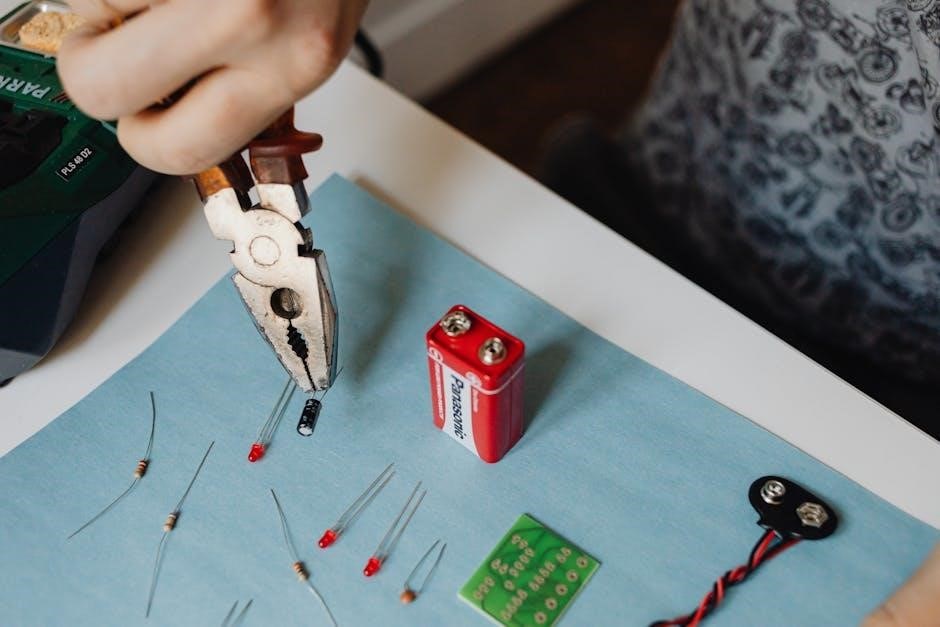
Snap Circuits Jr. utilizes uniquely designed components that snap together, eliminating the need for soldering. Each component has finger-like connectors, allowing for easy and secure connections on the project board. Understanding these parts is crucial for successful circuit building.

Components are color-coded and numbered for easy identification within the instruction manual. The kit includes passive components like resistors, which control current flow, and active components like LEDs and motors, which utilize that flow. Switches control the circuit’s on/off state. Recognizing each component’s function unlocks the potential for creative experimentation and project customization.

Resistors and Their Functions

Resistors, identified by their color bands, control the amount of electrical current flowing through a circuit. They limit current to protect components like LEDs from burning out. In Snap Circuits Jr., resistors are essential for regulating power and achieving desired effects within projects.

Different colored bands indicate a resistor’s resistance value, measured in Ohms. While the kit doesn’t heavily emphasize precise resistance calculations for beginners, understanding that higher resistance means less current flow is key. Resistors are often used in series with LEDs to dim their brightness or in parallel to distribute current. They are fundamental building blocks for circuit control.

LEDs: Light Emitting Diodes Explained

LEDs (Light Emitting Diodes) are semiconductor devices that emit light when an electric current passes through them. In Snap Circuits Jr., LEDs are used to visually demonstrate circuit functionality, creating illuminated projects. They have a positive (longer leg) and negative (shorter leg) side, requiring correct polarity for operation.

LEDs require a specific amount of current to light up; too much current can damage them, hence the importance of resistors in many LED circuits. The brightness of an LED depends on the current flowing through it. Experimenting with different resistor values allows you to observe how current limitation affects LED illumination, a core concept in electronics.

Switches: Controlling the Flow of Electricity

Switches are fundamental components in Snap Circuits Jr., acting as gatekeepers for electrical current. They open or close a circuit, controlling whether electricity can flow and, consequently, whether a component operates. Different switch types exist within the kit, including slide switches and push-button switches, each offering unique control mechanisms.

A slide switch maintains its position until physically changed, providing continuous on/off control. Push-button switches require constant pressure to remain closed, offering momentary operation. Understanding switch placement is crucial; they interrupt the circuit path, enabling users to start and stop functions like motor spins or light illumination.

Building Your First Circuit: A Step-by-Step Guide

Begin with Project 1 from the Snap Circuits Jr. manual – a simple light circuit. Locate the components: a battery snap, a slide switch (S1), a lamp (L1), and a baseplate. Carefully snap the components onto the baseplate, following the diagram precisely. Ensure each connection is secure; a loose connection prevents current flow.

Connect the battery snap to a fresh battery. Turn on the slide switch. If the lamp illuminates, congratulations – you’ve built your first circuit! If not, double-check all connections and battery polarity. This initial success builds confidence and demonstrates the fundamental principles of circuit building.

Safety Precautions When Using Snap Circuits Jr.

Always use the recommended battery type and voltage as specified in the Snap Circuits Jr. manual. Never mix old and new batteries, or different types of batteries. Adult supervision is recommended, especially for younger children. Do not attempt to power the circuits with any power source other than batteries.

Avoid short-circuiting components by directly connecting the battery snap terminals. Disconnect the battery when not in use or when modifying circuits. Inspect components regularly for damage; do not use damaged parts. Keep small parts away from young children to prevent choking hazards. Handle components with care to avoid bending or breaking them.

Troubleshooting Common Issues

If a Snap Circuits Jr. circuit isn’t working, first double-check all connections – ensure components are firmly snapped together. Verify battery polarity and that the batteries have sufficient charge. If a motor isn’t spinning, give it a gentle push to initiate movement; sometimes, it needs a starting nudge. Confirm component placement matches the project diagram exactly.

Inspect components for damage or incorrect orientation. If an LED doesn’t light, try reversing its polarity. If issues persist, systematically disconnect and reconnect each component, testing as you go. Refer to the manual for correct component identification and replacement if necessary.

Circuit Not Working: Identifying the Problem

When a Snap Circuits Jr. circuit fails to operate, begin with a visual inspection. Are all components securely snapped together? Loose connections are the most frequent cause of failure. Next, verify battery installation – correct polarity (+/-) is crucial. Check battery charge; weak batteries can prevent operation.

Trace the circuit path as shown in the manual. Ensure each component occupies the correct snap location. If a specific component seems suspect, temporarily remove it to see if the rest of the circuit functions; A systematic approach, combined with the project diagram, will pinpoint the issue efficiently.

Component Identification and Replacement

Snap Circuits Jr. components are clearly labeled with a unique code. Refer to the manual’s component list to identify each part by its code and function. If a component is damaged or malfunctioning, replacement is necessary for proper circuit operation.

Elenco Electronics offers replacement parts, often available through their website or hobby electronics retailers. When replacing, ensure the new component matches the original’s code exactly. Incorrect components can cause further issues or even damage the circuit. Handle components with care to avoid bending pins or damaging connections.

Exploring Project Categories

Snap Circuits Jr. projects are organized into diverse categories, fostering a broad understanding of electronics. Many projects focus on sound-related circuits, creating simple alarms, sirens, or even voice-changing effects using buzzers and integrated circuits.

Another exciting area is light-based projects, where LEDs are utilized to build flashing lights, light-sensitive alarms, and simple displays. Beyond these, you’ll find projects exploring motors, switches, and basic logic gates, providing a stepping stone to more complex electronic concepts. The manual guides you through each category, building skills progressively.

Sound-Related Projects

Snap Circuits Jr. excels in introducing basic audio concepts through engaging projects. You can build a working siren, experimenting with different resistor values to alter the tone. Simple alarms utilizing a buzzer and switch demonstrate how to create audible alerts.

More advanced projects allow for voice modification, showcasing how electronic components can manipulate sound waves. The motor (M1) can even be used in conjunction with sound circuits, creating unique effects. These projects teach fundamental principles of sound generation and control, all within a safe and educational framework.

Light-Based Projects

Snap Circuits Jr. provides numerous opportunities to explore the world of light and optics. Projects range from simple LED circuits, demonstrating basic illumination, to more complex configurations involving multiple LEDs and resistors to control brightness. The lamp (L1) can be creatively utilized, even as a wire in certain circuits, though it won’t illuminate in those instances.

Experimenting with different components allows users to understand how electricity interacts with light-emitting diodes. Building a flashing LED circuit introduces the concept of oscillation and timing. These projects lay a foundation for understanding light as a form of energy and the principles of electronic lighting systems.

Advanced Concepts Introduced in Snap Circuits Jr.

Snap Circuits Jr. subtly introduces advanced electronic concepts beyond simple connections. While remaining accessible, projects demonstrate principles like voltage division through resistor usage, impacting LED brightness or motor speed. The motor (M1) projects, requiring a manual push to initiate, hint at concepts of inertia and overcoming static friction.

Understanding how a slide switch (S1) controls current flow builds a foundation for logic gates. Observing circuit behavior encourages experimentation and problem-solving, fostering a deeper understanding of electrical engineering fundamentals. These projects aren’t explicitly taught, but are learned through hands-on exploration.

The Role of the Battery Snap Connector

The battery snap connector is fundamental to powering Snap Circuits Jr. projects, providing the necessary DC voltage. It securely connects to a standard 9V battery, establishing the circuit’s power source. Correct polarity is crucial; reversed connection won’t cause damage but prevents operation.

The connector’s design prioritizes safety, insulating the terminals to minimize risk. It’s a key component for initiating any circuit, and understanding its function is the first step in building successful projects. Always ensure a firm connection for reliable power delivery, especially when troubleshooting unresponsive circuits.

Understanding Circuit Diagrams

Snap Circuits Jr. utilizes simplified circuit diagrams to illustrate project construction. These diagrams aren’t complex schematics, but visual guides showing component placement and connections. Each component is represented by a symbol corresponding to its physical piece.

The diagrams emphasize how components snap together, rather than detailed electrical theory. Lines indicate connection points, and understanding these lines is key to successful builds. Following the diagram precisely ensures proper functionality. Learning to interpret these diagrams builds foundational skills for understanding more advanced electronics concepts later on.

Expanding Your Snap Circuits Collection

Snap Circuits Jr. offers a fantastic starting point, but the possibilities expand with additional kits! Consider the Snap Circuits SC-300 or SC-500 for more components and complex projects. These larger kits include motors, gears, and more sophisticated electronic parts, allowing for greater creative freedom.

Expansion packs focusing on specific themes – like sound or lights – are also available. Mixing and matching components from different kits unlocks entirely new project combinations. Always ensure compatibility when combining kits, and remember to carefully store all pieces for easy access and future builds!

Resources for Further Learning

Beyond the included manual, numerous online resources enhance the Snap Circuits Jr. experience. ManualsLib provides downloadable instruction manuals for various Snap Circuits kits, including the Jr. Select version, offering project guidance and component details.

Numerous YouTube channels feature tutorials and project demonstrations. Searching “Snap Circuits Jr. projects” reveals a wealth of user-created content. Online project databases compile builds from the community, inspiring new creations. Explore these resources to deepen your understanding and unlock even more electronic adventures!

Online Tutorials and Guides

YouTube is a fantastic resource for visual learners. Many channels dedicate content to Snap Circuits Jr., offering step-by-step project builds and explanations of electronic concepts. These tutorials often demonstrate troubleshooting techniques and provide alternative approaches to circuit construction.

Websites and blogs dedicated to electronics education frequently feature Snap Circuits Jr. projects. These guides often include detailed circuit diagrams, component lists, and explanations of the underlying principles. Searching online for specific projects or concepts will yield a wealth of helpful information, expanding your learning beyond the kit’s manual.

Snap Circuits Jr. Project Database

Several online communities and websites maintain extensive databases of Snap Circuits Jr. projects, often exceeding the number included in the original kit. These databases frequently feature user-submitted creations, offering inspiration and challenging builds for experienced users.

These resources often categorize projects by complexity, component usage, or electronic principle, making it easy to find circuits that match your skill level and interests. Many databases include detailed instructions, component lists, and even circuit diagrams, allowing you to recreate projects with ease. Explore these databases to unlock the full potential of your Snap Circuits Jr. kit!

Snap Circuits Jr. vs. Other Snap Circuit Kits

Snap Circuits Jr. is designed as an introductory kit for younger builders, typically ages 8 and up, focusing on fundamental electronic concepts with a simpler component selection. Compared to the original Snap Circuits or Snap Circuits Pro, Jr. offers fewer parts and projects, prioritizing ease of use and affordability.

Larger kits provide more advanced components like integrated circuits and more complex project options, catering to older children and hobbyists. The ‘Select’ versions offer curated project sets. Snap Circuits Jr. provides a fantastic starting point, but expanding to other kits unlocks greater creative potential and deeper learning opportunities.

Maintaining and Storing Your Snap Circuits Jr. Kit

Proper storage is crucial for longevity. After each use, ensure all components are free from dust and debris; a soft brush works well. Store the kit in its original box or a similarly sized container to prevent parts from getting lost or damaged.

Avoid exposing the kit to extreme temperatures or humidity, as this can affect the conductivity of the components. Regularly check the battery snap connector for corrosion. Careful handling of the snaps prevents breakage. A well-maintained kit ensures years of educational fun and successful circuit building!

Manuals

hayward aqua plus manual

Hayward Aqua Plus Manual: A Comprehensive Guide

This manual provides detailed instructions for operating and maintaining your Hayward Aqua Plus system, ensuring optimal pool sanitation and longevity.

Understanding the control panel, chlorination settings, and troubleshooting guides will empower you to efficiently manage your pool’s chemical balance.

Proper installation, regular maintenance, and adherence to safety precautions are crucial for maximizing performance and preventing potential issues.

The Hayward Aqua Plus is a sophisticated pool and spa control system designed to simplify water chemistry management and enhance the overall ownership experience. This system integrates multiple functions, including chlorination control, pump and equipment automation, and advanced diagnostics, all accessible through an intuitive user interface.

Unlike traditional methods, the Aqua Plus automates the process of maintaining ideal sanitizer levels, reducing the need for manual testing and adjustments. Whether utilizing a salt chlorine generator or traditional chemical feeders, the system provides precise control over chlorine output, ensuring a consistently clean and safe swimming environment.

Key to its functionality is the ability to monitor and adjust settings remotely, offering convenience and peace of mind. The Aqua Plus is compatible with various communication modules, enabling smartphone control and real-time alerts. This introduction will guide you through the system’s capabilities and provide a foundation for optimal operation and maintenance.

Understanding the Aqua Plus Control System

The Aqua Plus control system serves as the central hub for managing all pool functions. Its core lies in a microprocessor that continuously monitors water chemistry, equipment status, and user-defined settings. The system’s interface features a user-friendly display, providing real-time data and access to various control options.

Navigation through the menu system allows for adjustments to chlorine output percentages, pump schedules, and other critical parameters. The system utilizes sensors to measure salt levels (when applicable) and provides alerts when adjustments are needed. Understanding the display icons and messages is crucial for interpreting system status and addressing potential issues.

Furthermore, the Aqua Plus incorporates a cell timer that tracks the usage of the salt chlorine generator, prompting cleaning and inspection when necessary. The system’s advanced features, such as programming schedules and utilizing communication modules, enhance automation and remote control capabilities, offering a comprehensive pool management solution.

Key Features and Benefits

The Hayward Aqua Plus boasts a suite of features designed for effortless pool care. Central to its appeal is the integrated chlorination system, offering consistent and reliable sanitization. The ColorLogic LED functionality provides a visual indication of pool status, simplifying monitoring at a glance.

A significant benefit is the system’s ability to manage chlorine output, allowing users to fine-tune sanitizer levels for optimal water quality. The communication module enables remote control and monitoring, enhancing convenience and peace of mind. The three-year limited warranty underscores Hayward’s commitment to product reliability.

Moreover, the Aqua Plus simplifies pool maintenance through automated schedules and alerts, reducing manual intervention. Its compatibility with various pool types and sizes makes it a versatile solution for diverse needs, ultimately delivering a cleaner, safer, and more enjoyable swimming experience.

Installation and Setup

Proper installation is vital for optimal performance; carefully follow the provided manual’s wiring diagrams and sensor placement guidelines for a seamless setup.

Ensure correct electrical connections and calibrate sensors accurately to guarantee reliable operation and accurate readings from the start.

Initial System Setup

Before powering on your Hayward Aqua Plus system, thoroughly inspect all components for any shipping damage. Verify that you have all necessary parts as listed in the included parts list within the owner’s manual. Begin by physically mounting the control panel in a secure, weather-protected location, ensuring easy access for operation and maintenance.

Next, connect the system to a dedicated electrical circuit, adhering to all local electrical codes and safety regulations. It’s crucial to confirm the voltage matches the system’s requirements. Prior to introducing water to the system, prime the pump and plumbing lines to eliminate airlocks. Once primed, slowly introduce water, checking for any leaks at connection points.

Finally, before initiating chlorination, input your pool’s volume into the Aqua Plus control panel. This is essential for accurate chlorine output calculations. Allow the system to run for a short period to confirm proper operation before proceeding with further setup steps, like sensor calibration.

Wiring and Electrical Connections

Electrical work pertaining to the Hayward Aqua Plus system should only be performed by a qualified electrician, adhering strictly to local and national electrical codes. Ensure the power supply is completely disconnected at the breaker before commencing any wiring. The Aqua Plus typically operates on a 120V high voltage power supply, so verify compatibility.

Carefully connect the power cable to the designated terminal block within the control panel, ensuring a secure and tight connection. Properly ground the system to prevent electrical hazards. Wiring for auxiliary functions, such as communication modules or external relays, should follow the wiring diagrams provided in the installation manual.

Double-check all connections before restoring power. Incorrect wiring can cause system malfunction or pose a serious safety risk. Use appropriately sized wire gauges for the current draw of the system and any connected accessories. A three-year limited warranty covers product defects, but improper installation voids it.

Sensor Placement and Calibration

Accurate sensor readings are vital for optimal Aqua Plus performance. The chlorine/ORP sensor should be installed in a location with good water circulation, avoiding direct sunlight and close proximity to return jets. Proper placement ensures representative water samples are analyzed.

Calibration is essential for maintaining accuracy. Regularly calibrate the sensor following the procedures outlined in the owner’s manual. This typically involves using calibration solutions to establish a baseline reading. A clean probe is crucial; deposits can interfere with readings.

Inconsistent sanitizer levels often stem from a poorly calibrated or dirty sensor. The Aqua Plus control panel guides you through the calibration process. Ensure the system recognizes the correct sensor type. Accurate readings directly impact chlorine output, preventing over or under-sanitization.

Operating the Aqua Plus Control Panel

The Aqua Plus panel allows precise control over pool functions, including chlorine output, schedules, and diagnostic checks, ensuring optimal water quality and system performance.

Navigating the Menu System

Accessing the menu on your Hayward Aqua Plus control panel is straightforward. Begin by pressing the “Menu” button, initiating a scrollable list of options. Utilize the “Up” and “Down” arrow buttons to navigate through these choices, which include settings for chlorine output, schedules, cell timers, and system diagnostics.

To select a specific menu item, press the “Select” or “Enter” button. Once inside a menu, use the arrow buttons to adjust values or explore sub-menus. The “Back” button allows you to return to the previous screen, and the “Home” button will always return you to the main display.

Familiarize yourself with the menu structure to efficiently manage your pool’s automation system. Remember that accidental button presses can alter settings, so proceed with caution and review changes before exiting each menu. Consistent practice will make navigation intuitive.

Understanding Display Icons and Messages

The Hayward Aqua Plus control panel utilizes a variety of icons and messages to communicate system status. A “Check System” light indicates a potential issue requiring attention, often related to cell cleaning or salt levels. Low salt or mineral warnings signal the need to adjust water chemistry for optimal chlorine generation.

Other icons may represent pump status, cell activity, or communication module functionality. Pay close attention to any error messages displayed, as they provide valuable clues for troubleshooting. Refer to the owner’s manual for a complete list and explanation of all icons and messages.

Regularly monitoring the display panel allows for proactive identification of potential problems, preventing disruptions to your pool’s sanitation. Understanding these visual cues is essential for maintaining a healthy and enjoyable swimming environment.

Adjusting Chlorine Output Settings

To fine-tune chlorine production, access the chemical feed settings on the Hayward Aqua Plus control panel. Navigate to the chlorine output percentage, which typically ranges from 0% to 100%. Reducing the percentage lowers chlorine generation, while increasing it boosts output.

Start with small adjustments – for example, decreasing from 50% to 30% – and monitor sanitizer levels closely. Accurate probe readings are crucial; ensure the probe is clean and properly calibrated for reliable results.

Consider pool usage, sunlight exposure, and water temperature when setting chlorine output. Consistent monitoring and adjustments are key to maintaining ideal sanitizer levels and a sparkling clean pool.

Chlorination System Management

Effective chlorination relies on proper salt levels, regular cell cleaning, and prompt troubleshooting of low chlorine production issues for optimal sanitation.

Maintaining these aspects ensures consistent performance and extends the lifespan of your Aqua Plus chlorination system.

Salt Requirements and Levels

The Hayward Aqua Plus control system requires salt only when utilizing its chlorination features. If you are not employing the chlorinator, adhering to standard pool chemistry recommendations – excluding salt – is advised. Maintaining the correct salt level is paramount for efficient chlorine generation and cell longevity.

Typically, the Aqua Plus system functions optimally within a salt concentration range of 2700-3400 ppm (parts per million). However, always consult your owner’s manual for the precise recommended level for your specific model. Low salt or mineral levels trigger warnings on the control panel, indicating reduced chlorine production and potential cell degradation.

Regularly test your pool water’s salt content using a reliable salt test kit or strip. Adjust salt levels gradually, following the manufacturer’s instructions, to avoid over-saturation. Remember that water dilution from rainfall or backwashing can lower salt levels, necessitating periodic adjustments. Consistent monitoring and maintenance of proper salt levels are key to a sparkling and sanitized pool.

Cell Cleaning and Inspection

Regular cell cleaning is vital for maintaining optimal chlorine production with your Hayward Aqua Plus system. Scale buildup, caused by calcium and other minerals, reduces the cell’s efficiency. Inspect the cell periodically for visible scale accumulation. If scaling is present, initiate the cleaning cycle as outlined in your owner’s manual.

The Aqua Plus features an automatic cleaning cycle, activated through the control panel. During the cycle, the polarity of the cell reverses, helping to loosen scale. After the cleaning cycle completes, the system will prompt you to acknowledge the process.

For stubborn scale, manual cleaning may be necessary. Turn off the system and carefully remove the cell, following safety guidelines. Use a diluted muriatic acid solution (always add acid to water, never water to acid) specifically designed for salt cell cleaning. Rinse thoroughly before reinstalling. Resetting the cell timer after cleaning ensures accurate monitoring of cell life.

Troubleshooting Low Chlorine Production

Low chlorine output from your Hayward Aqua Plus system can stem from several factors. First, verify adequate salt levels; insufficient salt directly impacts chlorine generation. Confirm the salt reading on the control panel aligns with recommended levels (typically 2700-3400 ppm). A “Low Salt” or “Very Low Salt” warning indicates a need for salt addition.

Next, inspect the salt cell for scaling. Scale buildup hinders chlorine production. Initiate a cleaning cycle or perform manual cleaning as described in the maintenance section. Ensure the cell is properly installed and free of obstructions.

Also, check the flow rate. Insufficient water flow reduces chlorine contact time. Finally, confirm the chlorine output setting on the control panel is appropriately adjusted for your pool’s needs. If issues persist, consult the “Check System” light troubleshooting guide.

Advanced Settings and Features

Explore programmable schedules, communication module integration, and the innovative ColorLogic LED functionality for customized control and enhanced pool management capabilities.

These features allow for precise adjustments, remote monitoring, and visually informed insights into your pool’s sanitation status.

Programming Schedules and Timers

The Hayward Aqua Plus control system offers robust scheduling capabilities, allowing users to customize chlorination output based on pool usage patterns and environmental factors. Access the programming menu to establish multiple daily or weekly schedules, optimizing sanitizer levels for peak times and reducing chemical consumption during periods of inactivity.

Timers can be set to automatically adjust chlorine production, ensuring consistent water quality without manual intervention. This feature is particularly useful for vacation modes or seasonal adjustments. Users can define start and end times, as well as desired output percentages, for each schedule.

Experimenting with different schedules can significantly improve efficiency and reduce overall chemical costs. Remember to monitor water chemistry regularly to fine-tune settings and maintain optimal sanitation. The system’s intuitive interface simplifies the programming process, making it accessible for both novice and experienced pool owners.

Utilizing the Communication Module

The Hayward Aqua Plus communication module expands system functionality, enabling remote monitoring and control via compatible smart devices. This feature allows pool owners to adjust settings, receive alerts, and diagnose issues from anywhere with an internet connection. Installation typically involves connecting the module to the Aqua Plus control panel and configuring network settings.

Once connected, users can download a dedicated mobile app to access real-time data, including chlorine levels, salt concentration, and system status. Remote adjustments to output percentages and schedules are possible, providing convenient control over pool sanitation.

The communication module also facilitates proactive maintenance by sending notifications regarding low salt levels, cell cleaning reminders, or system errors. This ensures timely intervention and prevents potential problems, ultimately extending the lifespan of the equipment and maintaining pristine water quality.

ColorLogic LED Functionality

Hayward’s ColorLogic LED system, integrated with the Aqua Plus, offers a visual diagnostic tool through a multi-color light display. This intuitive feature provides instant feedback on system performance without requiring access to complex menu settings. The LED color indicates the current operational status, simplifying troubleshooting and maintenance.

For example, a solid green light typically signifies normal operation, while flashing red may indicate a system error or low salt level. Specific color combinations and flash patterns correspond to different alerts, detailed in the owner’s manual.

This visual cue allows for quick identification of potential issues, enabling prompt corrective action. The ColorLogic LED enhances user experience by providing a clear and concise overview of the Aqua Plus system’s health, promoting efficient pool care and peace of mind.

Troubleshooting Common Issues

This section details solutions for frequent problems like the “Check System” light, low salt warnings, and cell timer resets, ensuring smooth operation.

Addressing these issues promptly maintains optimal sanitation and prevents further complications with your Hayward Aqua Plus system.

“Check System” Light Troubleshooting

The “Check System” light on your Hayward Aqua Plus control panel indicates the system has detected a potential issue requiring attention. First, thoroughly inspect the salt cell; a dirty cell is a common culprit. Follow the cleaning instructions detailed in the owner’s manual, typically involving a mild acid solution.

After cleaning, press the button during the “Inspect Cell” display to reset the cell timer. If the light persists, verify adequate salt levels, as low salt or mineral content can trigger this warning. Ensure proper calibration of the probe for accurate readings. Low salt degrades cell life, so maintain recommended levels.

Additionally, check for any error codes displayed alongside the “Check System” light, as these provide more specific diagnostic information. Consult the manual’s troubleshooting guide for code definitions. If problems continue, contact a qualified pool technician for assistance, as it could indicate a more complex issue with the system’s components.

Addressing Low Salt/Mineral Warnings

A “Low Salt/Mineral” warning on your Hayward Aqua Plus signifies insufficient salt levels for optimal chlorine generation. This directly impacts sanitation and reduces the lifespan of the salt cell. First, test your pool water’s salt concentration using a reliable test kit or strip; the ideal range is typically between 2700-3400 ppm, but consult your manual.

If levels are low, add pool salt, following the manufacturer’s instructions for dosage based on pool volume. Ensure the salt dissolves completely before resuming operation. Very low salt levels can cause significant cell degradation, leading to costly repairs. Regularly monitor salt levels, especially after heavy rainfall or water dilution.

Remember that mineral content also plays a role; maintaining proper calcium hardness and alkalinity is crucial. Ignoring these warnings can result in ineffective sanitization and potential algae growth, so prompt action is essential for a healthy pool.

Resetting the Cell Timer

The cell timer on your Hayward Aqua Plus tracks cell usage and alerts you when cleaning is required. After a thorough cell cleaning, it’s crucial to reset the timer to ensure accurate monitoring and prevent unnecessary “Check System” alerts. To reset, navigate to the “Inspect Cell” display on the control panel.

During the “Inspect Cell” screen, press the designated button – typically the “Select” or “Enter” button – to acknowledge the cleaning and reset the timer. Failing to reset the timer after cleaning will result in continued alerts, even with a clean cell. Regular cell cleaning and timer resets maximize chlorine production efficiency.

Consult your owner’s manual for the specific button designation on your Aqua Plus model. Proper timer management extends cell life and maintains optimal sanitation, contributing to a sparkling clean pool experience.

Maintenance and Care

Regular system checks, including cell inspection and cleaning, are vital for peak performance. Winterizing properly protects the system from freeze damage, extending its lifespan.

Review the warranty details in the owner’s manual for claim procedures and coverage information regarding your Hayward Aqua Plus.

Regular System Checks

Consistent monitoring of your Hayward Aqua Plus system is paramount for maintaining optimal pool water quality and preventing costly repairs. Begin by visually inspecting the control panel for any error messages or unusual indicators, such as the “Check System” light.

Regularly examine the salt cell for scaling or buildup, as this directly impacts chlorine production efficiency. A clean cell ensures maximum output and prolongs its lifespan; follow the cleaning instructions detailed in the owner’s manual.

Verify salt levels are within the recommended range, typically between 2700-3400 ppm, using a reliable test kit or strip. Inaccurate readings can lead to insufficient chlorination or cell damage. Additionally, check the probe for cleanliness and proper calibration to guarantee accurate measurements. Finally, confirm all wiring connections are secure and free from corrosion.

Winterizing the Aqua Plus System

Proper winterization is crucial to protect your Hayward Aqua Plus system from freeze damage and ensure seamless startup in the spring. Begin by completely draining the system, including the cell, pump, and all associated plumbing lines. Utilize a shop vacuum to remove any remaining water from the cell housing.

Disconnect the power supply to the control panel and store it in a dry, protected location. If possible, remove the salt cell and store it indoors to prevent salt crystallization and potential corrosion. Inspect all O-rings and seals, replacing any that are worn or damaged.

Consider adding pool antifreeze to the plumbing lines for added protection in extremely cold climates. Finally, cover the entire system with a waterproof tarp to shield it from the elements, ensuring a trouble-free start when warmer weather returns.

Warranty Information and Claims

Hayward offers a limited warranty on the Aqua Plus system, typically covering defects in materials and workmanship for a specified period. Generally, this warranty spans three years on the product itself, as detailed in the owner’s manual. However, the warranty may not cover damage resulting from improper installation, misuse, or neglect.

To initiate a warranty claim, retain your original proof of purchase and contact Hayward customer support or an authorized service center. Be prepared to provide detailed information about the issue, including the system’s model number and date of installation.

Warranty claims may require inspection of the defective component and may be subject to repair or replacement at Hayward’s discretion. Review the full warranty documentation within the owner’s manual for complete terms and conditions.

Safety Precautions

Always prioritize electrical safety, handle pool chemicals with care, and follow all general safety warnings to prevent accidents and ensure safe operation.

Disconnect power before servicing, wear protective gear, and keep the control panel dry for optimal safety during maintenance and operation.

Electrical Safety Guidelines

Prioritize electrical safety when installing and maintaining your Hayward Aqua Plus system. Always disconnect the power supply at the breaker before performing any inspections, maintenance, or troubleshooting. Never work on electrical components with wet hands or while standing in water.

Ensure all wiring connections are secure and properly grounded, adhering to local electrical codes. Inspect wiring regularly for damage or wear, replacing any compromised components immediately. Avoid overloading circuits and use appropriate surge protection to safeguard the control panel from power fluctuations.

If you are uncomfortable working with electrical systems, consult a qualified electrician. Do not attempt repairs beyond your expertise. Remember that improper electrical work can lead to serious injury or system damage. Keep the Aqua Plus control panel dry and protected from the elements to prevent electrical hazards.

Chemical Handling Procedures

Always exercise extreme caution when handling pool chemicals used with your Hayward Aqua Plus system. Wear appropriate personal protective equipment (PPE), including gloves, eye protection, and a mask, to prevent skin and respiratory irritation. Never mix different chemicals together, as this can create dangerous reactions and hazardous fumes.

Store chemicals in a cool, dry, and well-ventilated area, away from direct sunlight and heat sources. Keep chemicals securely locked and out of reach of children and pets. When adding chemicals to the pool, always pour them into water, never water into chemicals.

Read and follow the manufacturer’s instructions on all chemical labels carefully. Dispose of empty chemical containers responsibly, following local regulations. In case of a chemical spill, immediately contain the spill and follow the safety guidelines provided on the product label.

General Safety Warnings

Prioritize safety when installing, operating, and maintaining your Hayward Aqua Plus system. Ensure all electrical connections are made by a qualified electrician and comply with local codes. Never operate the system with damaged cords or components. Regularly inspect the system for any signs of wear or damage.

Do not attempt to repair the system yourself; contact a qualified technician for assistance. Keep the area around the system clear of obstructions and flammable materials. Always disconnect power to the system before performing any maintenance or inspection.

Be aware of the potential for chlorine gas production and ensure adequate ventilation. Never bypass or disable any safety features. Supervise pool areas closely, especially when children are present. Follow all warnings and instructions provided in this manual.

Manuals

manual d3300 nikon

Nikon D3300: A Comprehensive User Guide

Nikon’s Manual Viewer 2 app facilitates offline access to D3300 guides on smartphones and tablets, available for free download on App Store and Google Play․

The Nikon D3300 is a versatile digital SLR camera designed for both beginners and enthusiasts seeking high-quality images․ This guide leverages resources like the Nikon Manual Viewer 2 app, offering convenient access to the comprehensive 392-page user manual in PDF format․

Understanding your D3300 is simplified through readily available documentation, including specifications and operational instructions․ The Nikon Manual Viewer 2, downloadable from the App Store and Google Play, allows offline viewing of manuals on iOS and Android devices․ This ensures you have essential information at your fingertips, even without an internet connection․

This camera boasts a Nikon F mount, supporting a wide range of compatible lenses․ Detailed documentation, including the D3400 Document of Compliance, provides further technical insights․

Key Features and Specifications

The Nikon D3300 is a 24․2 megapixel DX-format DSLR camera featuring a wide ISO range and robust autofocus system․ Key specifications are detailed within the 392-page user manual, accessible via the Nikon Manual Viewer 2 app for both iOS and Android․

This camera utilizes a Nikon F mount, ensuring compatibility with a vast lens ecosystem․ Documentation, including the D3400 Document of Compliance, outlines technical details․ The manual provides insights into features like Picture Control settings and Creative Effects mode․

Users can download the manual for free, benefiting from offline access through the app․ The D3300 is designed for professional-level photography, offering a blend of performance and user-friendly operation, all thoroughly explained in the provided resources․

Getting Started with Your D3300

Consult the 392-page user manual, downloadable via Nikon Manual Viewer 2, for initial setup, battery insertion, and memory card installation guidance․

Unboxing and Initial Setup

Upon receiving your Nikon D3300, carefully unpack the box, verifying all components are present․ The comprehensive user manual, accessible through the Nikon Manual Viewer 2 app (available on both App Store and Google Play), is your primary resource․ Before powering on, familiarize yourself with the camera’s layout using the manual’s diagrams․

Initial setup involves inserting the battery and a compatible memory card – refer to the manual for correct orientation and supported types․ Download the app to access the 392-page PDF guide, detailing each step․ Ensure the camera is fully charged before proceeding․ The manual provides clear instructions for language selection and date/time settings, crucial for proper operation and image organization․

Understanding the Camera Body and Controls

The Nikon D3300’s body features a familiar Nikon F mount, ensuring lens compatibility – consult the manual for tested models․ Key controls, detailed within the downloadable 392-page user guide (accessible via Nikon Manual Viewer 2 on App Store/Google Play), include the mode dial, shutter button, and control dials․

Familiarize yourself with the rear control panel, encompassing buttons for menu navigation, image playback, and autofocus settings․ The manual provides labeled diagrams illustrating each control’s function․ Understanding the placement of the diopter adjustment and viewfinder settings is also crucial․ The Nikon D3300’s design prioritizes ergonomic accessibility, as explained thoroughly within the comprehensive documentation․

Inserting the Battery and Memory Card

Before first use, insert a compatible battery into the D3300’s battery compartment, located on the camera’s bottom․ The user manual (available through Nikon Manual Viewer 2 on both App Store and Google Play) details the correct orientation and locking mechanism․ Simultaneously, insert a compatible SD memory card into the designated card slot, also found on the bottom․

Ensure the card clicks securely into place․ The 392-page manual provides visual guidance for both procedures․ Proper insertion is vital for powering the camera and storing captured images․ Refer to the documentation for supported SD card types and battery specifications to guarantee optimal performance and avoid potential issues․

Basic Photography with the D3300

The Nikon D3300 manual details Auto, Scene, and Manual shooting modes, alongside autofocus and manual focus techniques for capturing stunning images easily․

Shooting Modes: Auto, Scene, and Manual

The Nikon D3300 offers versatile shooting modes to suit various photographic situations․ Auto mode simplifies picture-taking, letting the camera handle all settings․ Scene modes, detailed in the manual, optimize settings for specific scenarios like portraits, landscapes, or sports, providing pre-configured adjustments for optimal results․

For experienced users, Manual mode grants complete control over aperture, shutter speed, and ISO, allowing for creative expression and precise image customization․ The D3300’s manual thoroughly explains each mode, guiding users through their functionalities and benefits․ Understanding these modes empowers photographers to capture images exactly as envisioned, from effortless snapshots to meticulously crafted compositions․ Experimentation with each mode unlocks the camera’s full potential․

Focusing Techniques: Autofocus and Manual Focus

The Nikon D3300 provides both Autofocus (AF) and Manual Focus (MF) options for precise image sharpness․ Autofocus utilizes the camera’s system to automatically achieve focus, offering various AF-area modes for different subjects and scenarios, detailed within the user manual․ Manual Focus allows photographers direct control over the lens focusing ring, ideal for situations where AF struggles or for precise artistic control․

The manual explains how to switch between AF and MF, and how to utilize focus points effectively․ Mastering both techniques is crucial for capturing consistently sharp images․ Understanding when to employ AF for speed and convenience, and MF for precision, enhances photographic control and creative possibilities with the D3300․

Understanding Exposure: Aperture, Shutter Speed, and ISO

Exposure, crucial for well-lit photographs, is controlled by three key settings: aperture, shutter speed, and ISO․ Aperture dictates the lens opening, influencing depth of field – the area in focus․ Shutter speed determines how long the sensor is exposed to light, impacting motion blur․ ISO measures the sensor’s sensitivity to light; higher ISOs are useful in low light but can introduce noise․

The Nikon D3300 manual thoroughly explains how these settings interact․ Mastering their relationship allows photographers to achieve desired brightness and creative effects․ Understanding how to adjust each setting in various shooting conditions is fundamental to utilizing the camera’s full potential and capturing consistently excellent images․

Advanced Photography Techniques

The Nikon D3300 manual details lens compatibility, Picture Control settings for customized image styles, and the Creative Effects Mode for artistic exploration;

Working with Lenses: Compatibility and Choices

The Nikon D3300 utilizes the Nikon F mount, offering broad lens compatibility․ The manual clarifies that while many Nikon lenses are compatible, testing confirms functionality with specific models like the D5000, D5100, D5200, D7000, and D7100․

Users should consult the manual for a detailed compatibility list before investing in lenses․ It’s crucial to verify compatibility to ensure optimal performance and avoid potential issues; The D3300 supports both Nikkor lenses designed for DX-format cameras and older lenses designed for the FX format, though the latter may require adjustments due to the smaller sensor size․

Choosing the right lens depends on the desired photographic style, ranging from the kit lens (18-55mm VR II) for general use to specialized lenses for portraits, landscapes, or macro photography․

Utilizing Picture Control Settings

Nikon’s Picture Control settings allow photographers to customize the look of their images directly within the D3300 camera․ The manual details several preset options, including Standard, Neutral, Vivid, Monochrome, Portrait, and Landscape․ Each Picture Control adjusts parameters like sharpness, contrast, brightness, and saturation to achieve a specific aesthetic․

Users can further refine these presets by accessing the Picture Control settings in the camera menu, allowing for fine-tuning of individual parameters․ Creating and saving custom Picture Controls enables photographers to consistently apply their preferred style to various shooting scenarios․

Experimenting with these settings is encouraged to discover the optimal look for different subjects and lighting conditions, enhancing creative control over the final image․

Exploring the Creative Effects Mode

The Nikon D3300 features a Creative Effects Mode offering a range of artistic filters for instant image enhancement․ These effects, accessible via the mode dial, allow photographers to experiment with different looks without complex post-processing․ Options include Night Vision, Pop Color, Selective Color, Silhouette, and Miniature Effect․

Each effect alters the image in a unique way, providing creative possibilities for various subjects․ The manual explains how to preview and adjust the strength of each effect in real-time on the camera’s LCD screen․

This mode is ideal for quickly adding a stylistic touch to photos, offering a fun and accessible way to explore different visual aesthetics and enhance photographic expression․

Navigating the Camera Menu

The D3300’s menu allows customization of settings, image management, and setup adjustments; the Nikon manual details each option for optimal camera control․

Customizing Camera Settings

The Nikon D3300 offers extensive customization options accessible through its menu system․ Users can tailor the camera to their specific shooting preferences, enhancing workflow and creative control․ The manual details how to adjust settings like image quality, file size, and white balance for optimal results in various conditions․

Furthermore, the D3300 allows personalization of autofocus modes, metering settings, and ISO range․ Customizing these parameters enables photographers to fine-tune the camera’s response to different scenes and subjects․ The Nikon Manual Viewer 2 app provides convenient access to these settings explanations, ensuring users fully understand each option’s impact on image capture․ Explore the menu to unlock the camera’s full potential and achieve desired photographic outcomes․

Understanding the Setup Menu

The Setup menu on the Nikon D3300 is crucial for configuring fundamental camera operations․ It encompasses settings like date/time, language, and display options, impacting the overall user experience․ Users can adjust the LCD screen’s brightness, information display, and viewfinder settings within this menu․

Additionally, the Setup menu controls essential functions such as file naming, slot selection for memory cards, and sensor cleaning․ The Nikon Manual Viewer 2 app offers detailed explanations of each setting, clarifying their purpose and potential effects․ Properly navigating this menu ensures the camera functions optimally and aligns with individual preferences․ Refer to the manual for a comprehensive understanding of each option and its implications for your photography․

Managing Images and Videos

The Nikon D3300 allows for efficient image and video management directly on the camera․ You can review captured files, delete unwanted ones, and protect important images from accidental deletion․ The camera supports playback with various display options, including histograms for exposure assessment․

Furthermore, images can be easily transferred to a computer via USB connection․ The Nikon Manual Viewer 2 app doesn’t directly manage files but guides users on accessing and utilizing the camera’s built-in management features․ Understanding these functions, detailed in the camera’s documentation, is vital for organizing and preserving your photographic work․ Proper file management ensures easy access and prevents data loss․

Using the Nikon Manual Viewer 2 App

Nikon’s app enables offline access to D3300 manuals on iOS and Android devices, offering convenient support via free downloads from App Store and Google Play․

Downloading and Installing the App

Nikon Manual Viewer 2 is readily available for download on both major mobile platforms․ iPhone, iPad, iPod touch, and Android users can access the application through their respective app stores․ Simply search for “Nikon Manual Viewer 2” within the App Store (for iOS devices) or Google Play (for Android devices)․

The download process is straightforward; tap the “Get” or “Install” button and follow the on-screen prompts․ Ensure you have a stable internet connection during the download․ Once installed, the app icon will appear on your device’s home screen․ Note that for the most current information regarding compatibility and updates, always refer to the official App Store or Google Play listings․

Accessing Manuals Offline

A key benefit of the Nikon Manual Viewer 2 app is the ability to download and access camera manuals – including the D3300’s – even without an internet connection․ After installing the app, navigate to the manual download section․ You’ll find a list of compatible Nikon digital SLR cameras․ Select the D3300 from the list to initiate the download process․

The manual will be stored directly on your device, allowing you to browse it anytime, anywhere, regardless of internet availability․ This is particularly useful when traveling or in situations where a data connection is unreliable․ Ensure sufficient storage space on your device before downloading the comprehensive 356-page D3300 manual (approximately 18MB)․

Benefits of the Digital Manual

The Nikon Manual Viewer 2 app offers several advantages over traditional printed manuals․ Its digital format allows for quick and easy searching, enabling users to instantly locate specific information about the D3300․ The app’s user-friendly interface provides convenient navigation through the 392-page guide, covering all aspects of camera operation and features․

Furthermore, the digital manual is always readily available on your smartphone or tablet, eliminating the need to carry a bulky paper copy․ Updates and revisions to the manual are easily delivered through the app, ensuring you always have the latest information․ Accessing the D3300 manual digitally promotes a more streamlined and efficient learning experience․

Troubleshooting Common Issues

Nikon’s documentation assists in resolving error messages, focusing problems, and optimizing battery life for the D3300, offering solutions within the digital manual․

Addressing Error Messages

Nikon D3300 error messages indicate specific camera issues, and the user manual is crucial for deciphering them․ The Nikon Manual Viewer 2 app provides readily available troubleshooting guidance, even offline․ Common errors relate to the battery, memory card, or lens compatibility․

Consult the manual’s dedicated section for each error code; it details potential causes and recommended solutions․ Often, simply re-inserting the battery or memory card resolves the problem․ Lens errors might necessitate checking compatibility or cleaning the contacts․ The downloadable PDF documentation (like the 356-page version) offers comprehensive details․ Remember to check Nikon’s official support website for the latest information and updates regarding specific error codes and their resolutions․

Resolving Focusing Problems

Nikon D3300 focusing issues can stem from several causes, detailed within the camera’s manual․ Utilizing the Nikon Manual Viewer 2 app allows quick access to troubleshooting steps․ Ensure the lens is securely attached and clean, as dirty contacts can hinder autofocus․ Verify the correct focus mode is selected – Auto (AF) for moving subjects, Manual (MF) for precise control․

If autofocus fails, try switching to single-point AF and selecting a high-contrast area․ The manual explains how to adjust AF-S/AF-C settings for different shooting scenarios․ Check for obstructions in front of the lens․ If problems persist, consult the manual’s section on focus lock and focus point selection for advanced techniques․ Remember to download the latest documentation for the most accurate guidance․

Battery Life and Power Management

The Nikon D3300’s battery life is a key consideration, detailed in the comprehensive user manual accessible via the Nikon Manual Viewer 2 app․ To maximize power, utilize the power-saving features outlined in the documentation, such as reducing LCD brightness and shortening the display off delay․ Avoid excessive use of live view, as it consumes significant battery power․

The manual also provides guidance on proper battery charging and storage․ Using a genuine Nikon charger is crucial for optimal performance and longevity․ Consider carrying a spare, fully charged battery for extended shooting sessions․ Understanding the camera’s power modes – Normal, Power Saving – is vital for efficient energy management, as explained within the downloadable guides․

Manuals

equate 4000 blood pressure monitor user manual

The Equate 4000 Series upper arm monitor is designed for simple, accurate home blood pressure monitoring, facilitating a consistent daily health regimen for users.

This device provides measurements equivalent to those obtained by a trained healthcare professional using a stethoscope, adhering to ANSI/AAMI Sp10 standards.

What is the Equate 4000 Series?

The Equate 4000 Series represents a line of advanced, automatic blood pressure monitors engineered for convenient and reliable home health monitoring. Specifically, the UA-4000WM model is a prominent example, offering wireless capabilities and seamless integration with the Equate Heart Chart app via Bluetooth connectivity.

These monitors are designed with user-friendliness in mind, aiming to simplify the process of tracking blood pressure and heart rate. They are intended for use on the upper arm, providing accurate readings comparable to those obtained through traditional auscultation methods performed by healthcare professionals. The series emphasizes ease of use, allowing individuals to proactively manage their cardiovascular health from the comfort of their homes.

Furthermore, the Equate 4000 Series incorporates a built-in clock, automatically synchronized with a paired mobile device, ensuring accurate time-stamping of each measurement for comprehensive data tracking;

Intended Use and Accuracy

The Equate 4000 Series blood pressure monitor is primarily intended for non-invasive home monitoring of blood pressure and pulse rate in adults. It’s designed to help individuals track their cardiovascular health and share data with healthcare providers.

Regarding accuracy, measurements obtained with this device are statistically equivalent to those achieved by a trained observer utilizing the cuff/stethoscope auscultation method. This equivalence adheres to the stringent limits prescribed by the American National Standard (ANSI/AAMI Sp10) for electronic or automated blood pressure measuring devices.

Important Note: Do not apply the cuff to limbs with IV lines, arterial-venous shunts, or other intravascular access points, as inflation may temporarily impede blood flow. Always consult with a medical professional for diagnosis and treatment.

Package Contents

Your Equate 4000 Series package includes the blood pressure monitor, upper arm cuff, user manual, and batteries for immediate operation and health tracking.

Components Included

The Equate 4000 Series Blood Pressure Monitor package is thoughtfully assembled to ensure a seamless user experience from the start. Inside the box, you will find the main monitor unit itself, designed for ease of use and accurate readings. A comfortable, adjustable upper arm cuff is also included, sized to fit a standard adult arm circumference.

To power your monitor, a set of batteries is provided, allowing for immediate operation without the need for separate purchase. Crucially, a detailed user manual is included, offering step-by-step instructions on setup, measurement techniques, understanding your results, and troubleshooting common issues. This manual is your comprehensive guide to maximizing the benefits of your Equate 4000 monitor and maintaining your cardiovascular health.

Identifying the Parts

Familiarizing yourself with the Equate 4000’s components is key to proper operation; The monitor features a clear LCD display, showcasing systolic and diastolic blood pressure readings, pulse rate, and date/time information. Below the display is the ‘Start/Stop’ button, initiating and halting measurements.

The cuff connector port is located on the left side of the unit, where the air tube from the cuff attaches. The upper arm cuff itself consists of the inflatable bladder encased in fabric, a Velcro closure for secure fitting, and the air tube connecting to the monitor. Note the Bluetooth symbol, indicating wireless connectivity for data synchronization with the Equate Heart Chart app. Understanding these parts ensures accurate setup and reliable blood pressure monitoring for your health management.

Setting Up Your Monitor

Proper setup is crucial for accurate readings. This involves installing batteries correctly and securely attaching the cuff to the monitor, ensuring a firm connection.

Installing Batteries

To begin, locate the battery compartment, typically found on the back or underside of the Equate 4000 monitor. Gently slide open the compartment cover. Insert the required number of batteries – usually four AAA batteries – following the polarity markings (+ and -) inside the compartment.

Ensure the batteries are inserted correctly to avoid damaging the monitor. Once the batteries are in place, carefully close the battery compartment cover, confirming it clicks securely shut. If the display does not illuminate or shows a low battery indicator, double-check the battery installation and replace batteries if necessary.

Always use new, high-quality batteries for optimal performance and accuracy; Avoid mixing old and new batteries, or different types of batteries. Properly dispose of used batteries according to local regulations.

Attaching the Cuff

Carefully unfold the cuff and ensure the artery marker (usually an arrow) is positioned correctly, aligning with the major artery on your upper arm – typically on the inner side. Slide the cuff over your upper arm, approximately one inch (2-3 cm) above your elbow.

Ensure the cuff is snug but not too tight; you should be able to comfortably slide one finger between the cuff and your arm. Do not attach the cuff over clothing, as this can affect the accuracy of the reading. Avoid applying the cuff to a limb with an IV infusion, A-V shunt, or other intravascular access.

Secure the cuff firmly with the hook and loop fastener. The cuff should be positioned at heart level for accurate measurements. Proper cuff placement is crucial for reliable blood pressure readings.

Taking a Measurement

To obtain accurate readings, ensure proper positioning and follow the step-by-step guide; remaining still during measurement is essential for reliable results with the Equate 4000.

Proper Positioning

Achieving accurate blood pressure readings relies heavily on correct positioning during measurement. Sit comfortably with your back supported and your feet flat on the floor – avoid crossing your legs.

Ensure your arm is supported at heart level, ideally on a table or armrest. The cuff should be placed on your upper arm, approximately one inch above the bend of your elbow.

Avoid talking or moving during the measurement process, as this can artificially inflate your blood pressure. Relax for at least five minutes before taking a reading, and ensure you haven’t consumed caffeine, smoked, or exercised within 30 minutes prior.

Incorrect positioning can lead to inaccurate results, so taking the time to prepare properly is crucial for effective blood pressure monitoring with the Equate 4000.

Step-by-Step Measurement Guide

Follow these steps for accurate readings with your Equate 4000 blood pressure monitor. First, ensure the cuff is securely attached to your upper arm, positioned correctly at heart level.

Press the ‘START’ button to initiate the measurement. The cuff will automatically inflate, and you should remain still and silent throughout the process.

The monitor will display your systolic and diastolic blood pressure, along with your heart rate. Note these values carefully.

If an error occurs, refer to the troubleshooting section of this manual. Repeat the measurement if necessary, ensuring proper positioning each time. Remember to allow a brief interval between consecutive measurements.

Data will be stored with the time and date, thanks to the built-in clock.

Understanding Your Readings

The Equate 4000 displays systolic and diastolic pressure, alongside your heart rate. Interpreting these values helps track cardiovascular health and identify potential concerns.

Systolic and Diastolic Pressure

Systolic pressure, the top number, represents the force against your artery walls when your heart beats. It indicates the pressure during ventricular contraction. Conversely, diastolic pressure, the bottom number, measures the force against your artery walls while your heart rests between beats, reflecting pressure during ventricular relaxation.

Understanding both values is crucial for a complete assessment. Generally, normal blood pressure falls below 120/80 mmHg. Elevated systolic pressure alone is common with age, while consistently high diastolic readings require attention. Regularly monitoring both provides valuable insights into your cardiovascular health. Consult a healthcare professional for personalized interpretation and guidance based on your readings and medical history. Accurate tracking with the Equate 4000 aids in informed healthcare discussions.

Heart Rate Interpretation

The Equate 4000 also measures your heart rate in beats per minute (BPM), providing a valuable indicator of cardiovascular function. A normal resting heart rate generally falls between 60 and 100 BPM, though this can vary based on fitness level, stress, and medication.

Consistently high or low heart rates outside this range warrant medical attention. Elevated rates may indicate stress, dehydration, or underlying medical conditions, while lower rates could suggest excellent fitness or, in some cases, require evaluation. Tracking your heart rate alongside blood pressure readings offers a more comprehensive view of your health. Remember to note any factors that might influence your heart rate during measurement, such as recent exercise or caffeine intake, when discussing results with your doctor.

Memory Function and Data Review

The Equate 4000 stores measurement data, including date and time, allowing you to easily recall previous readings and track trends in your blood pressure.

Storing Measurement Data

The Equate 4000 Series blood pressure monitor automatically saves each measurement taken, along with the precise date and time of the reading. This feature is crucial for tracking your blood pressure trends over time and providing valuable data to your healthcare provider.

The monitor’s memory capacity allows for the storage of a significant number of readings, enabling a comprehensive history of your blood pressure levels. This stored data is invaluable for identifying patterns, assessing the effectiveness of any lifestyle changes or medications, and making informed decisions about your health.

Each reading is securely stored within the device, ensuring that your personal health information remains private and readily accessible when needed. The consistent recording of data empowers you to actively participate in managing your cardiovascular health and maintaining a proactive approach to wellness.

Recalling Previous Readings

To review your stored blood pressure measurements, utilize the memory recall function on the Equate 4000 monitor. This allows you to easily access past readings and monitor your blood pressure trends over days, weeks, or even months. The process typically involves pressing a dedicated “Memory” or “Recall” button on the device.

The monitor will then display the previously recorded readings, often showing the systolic and diastolic pressure, pulse rate, and the date and time the measurement was taken. You can usually cycle through the stored data using the same button, allowing you to review your complete history.

Regularly reviewing your readings can help you identify any significant changes or patterns, which you can then discuss with your doctor. This proactive approach to monitoring your health empowers you to make informed decisions and maintain optimal cardiovascular wellness.

Bluetooth Connectivity & Equate Heart Chart App

The Equate 4000 seamlessly connects via Bluetooth to the Equate Heart Chart app, enabling data synchronization and comprehensive tracking of your blood pressure readings.

Pairing with Your Mobile Device

To establish a Bluetooth connection between your Equate 4000 monitor and your mobile device, first ensure Bluetooth is enabled on your smartphone or tablet. Open the Equate Heart Chart app and follow the on-screen instructions to initiate the pairing process.

The app will guide you through searching for available devices. Select your Equate 4000 monitor from the list. During pairing, a Bluetooth symbol will illuminate on the monitor, confirming the connection attempt. You may be prompted to enter a pairing code, if required, which will be displayed within the app.

Once successfully paired, the app will automatically synchronize with the monitor, allowing for seamless data transfer. Ensure the monitor is within range of your mobile device during synchronization. Refer to the app’s help section for detailed troubleshooting steps if pairing fails.

Data Synchronization and Tracking

Following successful pairing, your Equate 4000 monitor will automatically synchronize measurement data with the Equate Heart Chart app via Bluetooth. This process ensures your blood pressure and heart rate readings are securely stored and readily accessible on your mobile device.

Within the app, you can track your readings over time, viewing trends and patterns in your blood pressure. The app provides graphical representations of your data, making it easier to understand your cardiovascular health. The built-in clock automatically records the date and time of each measurement, providing a comprehensive history.

Regular data synchronization allows for informed discussions with your healthcare provider. The app facilitates easy sharing of your blood pressure data, aiding in accurate diagnosis and treatment planning.

Troubleshooting Common Issues

If error messages appear, consult the manual for specific meanings. Inaccurate readings can stem from improper cuff placement or movement during measurement.

Error Messages and Their Meanings

The Equate 4000 monitor utilizes error messages to indicate potential issues during measurement. Understanding these alerts is crucial for accurate readings and proper device function. An “Err” display, often accompanied by a number, signals a specific problem.

For instance, “Err 1” typically indicates a cuff inflation error – ensure the cuff is correctly attached and not too tight. “Err 2” suggests excessive movement during the measurement process; remain still. “Err 3” may point to a low battery, requiring replacement. If you encounter a persistent error not listed, or if the monitor continues to malfunction, discontinue use and consult the full user manual or contact customer support.

Always refer to the complete manual for a comprehensive list of error codes and their corresponding solutions, ensuring optimal performance and reliable blood pressure monitoring.

Inaccurate Readings ー Potential Causes

Several factors can contribute to inaccurate blood pressure readings with the Equate 4000. Improper cuff placement is a common issue; the cuff should be snug but not overly tight, positioned correctly on the upper arm. Movement during measurement significantly impacts results – remain still and relaxed throughout the process.

External factors, like talking or crossing your legs, can also elevate readings. Avoid caffeine, alcohol, and smoking for at least 30 minutes before measurement. Do not apply the cuff over clothing or on a limb with an IV or A-V shunt, as this will interfere with accurate blood flow assessment.

Ensure the correct cuff size is used, and regularly calibrate the device as recommended in the user manual for continued reliability.

Maintenance and Care

Regularly clean the monitor and cuff with a soft, damp cloth; avoid harsh chemicals. Store the device in a cool, dry place, protected from direct sunlight.

Cleaning the Monitor and Cuff

To ensure accurate readings and prolong the life of your Equate 4000 Blood Pressure Monitor, regular cleaning is essential. Always disconnect the cuff from the monitor before cleaning. Use a soft, slightly damp cloth to gently wipe the monitor’s surface and the cuff material.

Avoid using harsh chemical cleaners, solvents, or abrasive materials, as these can damage the device and affect its accuracy. Do not immerse the monitor or cuff in water. For stubborn stains on the cuff, a mild detergent diluted in water can be used, but ensure all soap residue is removed with a clean, damp cloth.

Allow both the monitor and cuff to air dry completely before reattaching and storing. Regularly inspect the cuff for cracks or damage; a damaged cuff can lead to inaccurate readings. Proper cleaning and care will help maintain the performance and reliability of your Equate 4000 monitor.

Storage Guidelines

Proper storage is crucial for maintaining the longevity and accuracy of your Equate 4000 Blood Pressure Monitor. When not in use, store the monitor and cuff in a cool, dry place, away from direct sunlight and extreme temperatures. Avoid storing the device in areas with high humidity, as this can damage the electronic components.

It’s recommended to store the monitor in its original packaging or a protective case to prevent dust accumulation and physical damage. Do not store the cuff tightly wound, as this can cause it to lose its elasticity over time. Gently roll or loosely fold the cuff for storage.

Keep the batteries removed from the monitor if it will be stored for an extended period to prevent corrosion. Ensure the storage location is easily accessible for regular use and maintenance checks. Following these guidelines will help ensure your Equate 4000 remains in optimal condition.

Manuals

fha manual underwrite guidelines

FHA Manual Underwrite Guidelines: A Comprehensive Overview (Updated 01/27/2026)

FHA manual underwriting provides a pathway for borrowers who don’t fit neatly into automated systems․ It requires a detailed review of financial documentation,
ensuring compliance with FHA requirements, and careful consideration of compensating factors․

FHA manual underwriting represents a crucial alternative to automated systems, offering a pathway for borrowers with unique financial circumstances․ Unlike Automated Underwriting System (AUS) approvals, manual underwriting demands a meticulous, in-depth review of each borrower’s complete financial profile․ This process is essential when AUS results are unfavorable or when a loan presents complexities that require human assessment․

The core principle of manual underwriting lies in verifying the borrower’s creditworthiness through documented evidence․ Lenders thoroughly analyze income stability, employment history, debt obligations, and asset reserves․ This detailed scrutiny ensures the borrower’s ability to repay the mortgage, aligning with FHA’s commitment to responsible lending․

While more time-consuming, manual underwriting allows for a nuanced understanding of a borrower’s situation, considering compensating factors that an algorithm might overlook․ It’s particularly relevant for self-employed individuals, those with non-traditional income sources, or borrowers recovering from past credit challenges․ Ultimately, FHA manual underwriting aims to expand access to homeownership while maintaining prudent risk management․

When is Manual Underwriting Required?

FHA manual underwriting becomes necessary in several specific scenarios․ Primarily, it’s required when an Automated Underwriting System (AUS) delivers a referral or caution status, indicating the loan doesn’t meet automated approval criteria․ This often occurs with complex financial situations that require a human underwriter’s judgment․

Self-employment frequently triggers a manual review, as income verification can be more intricate than with traditional W-2 employment․ Similarly, borrowers with limited credit history, or those relying on non-taxable income sources, often necessitate manual assessment․ Loans exceeding FHA loan limits may also require it․

Furthermore, if a borrower has experienced credit events – such as foreclosures or bankruptcies – within a specified timeframe, a manual underwrite is generally mandated․ Lenders must demonstrate to FHA that mitigating factors exist and the borrower has re-established creditworthiness․ Ultimately, any deviation from standard AUS guidelines typically necessitates a thorough manual review process․

FHA Minimum Property Requirements (MPR) for Manual Underwrites

FHA Minimum Property Requirements (MPR) are crucial during manual underwriting, ensuring the property meets safety, security, and livability standards; These requirements are non-negotiable and apply regardless of the underwriting method․ Appraisers meticulously assess properties for structural integrity, including the foundation, roof, and exterior walls․

Deficiencies like peeling paint (lead-based paint hazards), faulty electrical systems, or plumbing issues must be addressed before loan approval․ Adequate heating and ventilation are essential, as is a functioning roof free from leaks․ The property must provide safe and sanitary conditions for occupants․

During a manual review, underwriters scrutinize the appraisal report for MPR compliance․ Any noted deficiencies require a clear plan for remediation, often with associated costs․ FHA mandates that repairs are completed to meet MPR standards, protecting both the borrower and the agency’s investment․ A property failing to meet MPRs will not be approved for FHA financing․

Appraisal Requirements for Manual Underwrites

Appraisal requirements are significantly important in FHA manual underwriting, serving as the foundation for property value and condition assessment․ FHA requires appraisals to be conducted by FHA-approved appraisers, ensuring competency and adherence to specific guidelines․

The appraisal must accurately reflect the market value of the property, utilizing comparable sales data․ A detailed description of the property’s features, condition, and any potential issues is essential․ The appraisal report must clearly identify any Minimum Property Requirement (MPR) deficiencies, as these directly impact loan eligibility․

For manual underwrites, the appraiser’s narrative is carefully reviewed․ Underwriters assess the reasoning behind the appraised value and the thoroughness of the property inspection․ Any discrepancies or concerns necessitate further investigation․ A well-supported and compliant appraisal is critical for securing FHA loan approval, especially when automated systems aren’t utilized․

Income Assessment in Manual Underwriting

Income assessment is a cornerstone of FHA manual underwriting, demanding meticulous verification and analysis․ Unlike automated systems, manual underwriting requires a deep dive into the borrower’s earnings history and stability․ Underwriters scrutinize pay stubs, W-2s, and tax returns to confirm reported income․

A key focus is on the consistency and reliability of income sources․ Self-employment income requires particularly thorough documentation, including profit and loss statements and business tax returns․ Any fluctuations or inconsistencies must be adequately explained․ Borrowers must demonstrate a stable employment history, typically at least two years in the same field․

Underwriters carefully evaluate all income sources, including salaries, wages, bonuses, commissions, and other forms of earnings․ The goal is to determine the borrower’s true ability to repay the loan, considering both current income and potential future earnings․ Accurate income assessment is vital for responsible lending and minimizing risk․

Verifying Income: Documentation Checklist

FHA manual underwriting necessitates a comprehensive income verification process․ A detailed documentation checklist is crucial for a smooth and accurate assessment․ Borrowers must provide the most recent two years of W-2 forms for all employment, showcasing consistent earnings․

For self-employed individuals, submit signed federal tax returns (including all schedules) for the past two years, alongside a year-to-date profit and loss statement․ Pay stubs covering the most recent 30 days are essential, verifying current income levels․ If income is received from sources like alimony or child support, provide official court documentation․

Additional documents may include verification of Social Security benefits, pension statements, or other recurring income sources․ Any explanations for income gaps or inconsistencies must be provided in writing․ A complete and organized documentation package streamlines the underwriting process and demonstrates borrower transparency․

Debt-to-Income (DTI) Ratio Calculations

FHA DTI ratio calculations are fundamental in manual underwriting, assessing a borrower’s ability to manage monthly debt obligations․ The calculation involves dividing total monthly debt payments by gross monthly income․ Total debt includes the proposed mortgage payment (principal, interest, taxes, and insurance – PITI), plus all other recurring debts․

Recurring debts encompass credit card minimums, auto loans, student loans, child support, and alimony․ Accurate income documentation is vital for precise calculations․ Lenders carefully scrutinize income sources to determine qualifying income, excluding non-taxable income in some cases․

FHA guidelines specify maximum allowable DTI ratios, but these can be exceeded with compensating factors․ A detailed analysis of the borrower’s credit profile and financial stability is crucial․ Proper DTI calculation ensures responsible lending and minimizes the risk of default, aligning with FHA’s lending objectives․

Allowable DTI Ratios According to FHA

FHA establishes maximum DTI ratios, but flexibility exists within those guidelines during manual underwriting․ Generally, a total DTI ratio of 43% or less is preferred, indicating a comfortable debt burden relative to income․ However, FHA permits ratios up to 50% in certain circumstances, particularly with a strong credit profile and compensating factors․

The “back-end” DTI, encompassing all debts, receives primary focus․ A “front-end” DTI, considering only housing expenses, typically shouldn’t exceed 31%․ These are guidelines, not rigid rules; manual underwriting allows for nuanced evaluation․

Compensating factors—like substantial reserves, a stable employment history, or a low loan-to-value ratio—can justify exceeding these ratios․ Lenders must document the rationale for approving higher DTIs, demonstrating the borrower’s capacity to repay the loan despite increased debt obligations, adhering to responsible lending practices․

Credit Requirements for FHA Manual Underwrites

FHA loan programs are known for their credit flexibility, but borrowers still need to demonstrate a reasonable credit history, even with manual underwriting․ While a minimum credit score of 500 is technically possible with a 10% down payment, most lenders prefer a score of 580 or higher for manual approvals․

A manual underwrite dives deeper than a score, scrutinizing the entire credit report․ Lenders assess payment history, the types of credit accounts, and the overall credit utilization․ Recent bankruptcies, foreclosures, or collections require thorough explanation and a demonstrated recovery period․

FHA emphasizes responsible credit behavior․ Manual underwriters look for patterns, not just isolated incidents․ A history of on-time payments, even with limited credit, can outweigh a slightly lower score․ Documenting extenuating circumstances surrounding past credit issues is crucial for a successful manual review․


Minimum Credit Score Considerations

While FHA guidelines allow for credit scores as low as 500 with a 10% down payment, securing a loan with manual underwriting at this level is challenging․ Lenders typically overlay their own minimum score requirements, often starting at 580 for manual review consideration․

A score between 500-579 necessitates a significantly stronger compensating factor profile – substantial reserves, a long and stable employment history, and a low debt-to-income ratio․ Expect increased documentation requests and a more rigorous assessment of creditworthiness․

Borrowers with scores above 620 generally experience a smoother manual underwriting process․ This range demonstrates a solid credit history and reduces the need for extensive compensating factors․ However, even with a higher score, a manual underwrite still requires a detailed examination of the entire credit report, not just the numerical value․

Analyzing Credit Report Derogatory Marks

FHA manual underwriting demands a thorough analysis of any derogatory marks on a borrower’s credit report․ Underwriters don’t automatically disqualify applicants; they assess the nature, frequency, and explanation behind negative credit events․

Recent bankruptcies (typically within the last two years) require a detailed explanation and demonstrated re-establishment of credit․ Foreclosures and short sales usually necessitate a waiting period (typically three years) and evidence of financial recovery․

Collections and charge-offs are scrutinized for amount, age, and whether they’ve been paid․ A pattern of frequent collections raises red flags․ Judgments require documentation of satisfaction or a clear payment plan․

Crucially, the underwriter evaluates the borrower’s explanation for the derogatory marks․ Documented hardship, such as job loss or medical expenses, is viewed more favorably than a lack of financial responsibility․ A well-documented explanation is key to a successful manual underwrite․

Employment History Verification

FHA manual underwriting places significant emphasis on verifying a borrower’s employment history to ensure stable and reliable income․ Underwriters require more than just pay stubs; they seek a comprehensive understanding of the borrower’s job situation․

Typically, a Verification of Employment (VOE) form is sent directly to the employer to confirm current employment status, position, and income․ Two years of employment history are generally expected, though exceptions can be made with a reasonable explanation for shorter tenures․

If the borrower has recently changed jobs, the underwriter will scrutinize the reason for the change and assess the stability of the new position․ Self-employment requires detailed analysis of tax returns (typically two years) and profit & loss statements․

Gaps in employment must be adequately explained with supporting documentation, such as unemployment records or letters of explanation․ Consistent employment demonstrates responsibility and the ability to repay the loan․

Length of Employment & Stability

FHA guidelines prioritize employment stability when conducting a manual underwriting review․ A minimum of two years with the current employer is generally preferred, demonstrating a consistent work history and reliable income stream․ However, exceptions are possible with sufficient compensating factors․

If a borrower has less than two years with their current employer, the underwriter will examine their overall employment history․ A pattern of frequent job changes raises concerns, while a solid work record prior to the current position can be viewed favorably․

Stability isn’t solely about tenure; the type of employment matters․ Permanent, full-time positions are considered more stable than temporary or contract work․ Self-employment requires a longer track record – typically two years – to demonstrate consistent earnings․

Any breaks in employment must be explained and documented․ A well-documented explanation, such as returning to school or caring for a family member, can mitigate concerns about employment gaps․

Assets and Reserves Requirements

FHA loan guidelines require borrowers to demonstrate sufficient assets and reserves to cover down payment, closing costs, and a financial cushion for unforeseen circumstances․ These requirements are crucial during manual underwriting, showcasing the borrower’s ability to manage homeownership expenses․

Acceptable asset sources include savings accounts, checking accounts, retirement funds (with limitations), and proceeds from the sale of assets․ Funds must be seasoned – meaning they’ve been in the borrower’s account for a specified period, typically 60 days, to prevent concerns about borrowed funds․

Reserve requirements vary based on loan characteristics, such as the loan amount and the number of borrowers․ Generally, lenders seek at least one to three months of mortgage payments, including principal, taxes, and insurance (PTI), in reserve․

Insufficient reserves don’t automatically disqualify a borrower, but they may necessitate compensating factors, like a strong credit history or a stable employment record․ Thorough documentation of all assets is essential for a successful manual underwrite․

Acceptable Sources of Funds

FHA guidelines meticulously outline acceptable sources of funds for down payments, closing costs, and reserves during a manual underwriting process․ Demonstrating legitimate fund origins is paramount for loan approval, ensuring borrowers aren’t relying on undisclosed debt․

Commonly accepted sources include verified savings accounts, checking accounts, and proceeds from the sale of documented assets like stocks or bonds․ Retirement accounts can be utilized, but often with restrictions and potential tax implications, requiring careful review․

Gift funds are permissible, but must adhere to strict donor requirements, including a signed gift letter stating no repayment expectation․ Borrowed funds are generally not allowed, as they create an undisclosed liability․

All funds require thorough documentation, including bank statements and source verification․ Seasoning requirements typically apply, demanding funds be held in the borrower’s account for a specified period (usually 60 days) to validate legitimacy․ Lenders scrutinize fund transfers to prevent fraud․

Required Reserve Amounts

FHA mandates reserve requirements to safeguard against potential mortgage payment defaults, particularly crucial during manual underwriting where risk assessment is more nuanced․ Reserves represent liquid assets available to the borrower after closing costs and down payment are satisfied․

Generally, FHA requires at least three months of mortgage payments (Principal, Interest, Taxes, and Insurance ─ PITI) in reserve․ However, the specific amount can fluctuate based on factors like loan amount, credit score, and debt-to-income ratio․

Borrowers with higher DTIs or lower credit scores may face increased reserve demands․ Streamlined refinance options often have reduced or waived reserve requirements․ Documentation verifying sufficient reserves is essential, typically through bank statements․

Acceptable reserve assets include savings accounts, checking accounts, and readily convertible investments․ Retirement accounts may be considered with limitations․ Lenders carefully evaluate the accessibility and liquidity of these funds to ensure they genuinely serve as a financial safety net․

Gift Funds: FHA Guidelines

FHA permits the use of gift funds towards the down payment, closing costs, and other allowable expenses, offering assistance to borrowers․ However, strict guidelines govern these contributions to prevent hidden debt or undue influence․

The donor must be a family member or a legal guardian․ A formal gift letter, signed by both the donor and the borrower, is mandatory․ This letter must explicitly state the funds are a gift, with no expectation of repayment․

FHA requires documentation verifying the donor’s funds’ source․ This may include bank statements, gift tax returns (if applicable), or evidence of a legitimate sale of assets․ The funds must be properly seasoned – typically, they should be in the donor’s account for a specified period․

The lender will scrutinize the gift transaction to ensure it complies with FHA regulations and anti-money laundering laws․ Proper documentation and transparency are crucial for successful gift fund utilization in an FHA loan․

Manual Underwrite vs․ Automated Underwriting (AUS)

Automated Underwriting Systems (AUS), like those offered by Fannie Mae (Desktop Underwriter) and Freddie Mac (Loan Prospector), rapidly assess loan risk using algorithms․ They streamline the process for standard loan scenarios, providing quick decisions․

However, manual underwriting steps in when AUS results are unfavorable, or the loan presents complexities – non-traditional credit, irregular income, or unique property characteristics․ It involves a loan underwriter meticulously reviewing each aspect of the borrower’s financial profile and the property․

While AUS focuses on standardized criteria, manual underwriting allows for greater flexibility and consideration of compensating factors․ It’s a more in-depth process, demanding thorough documentation and analytical skills from the underwriter․

FHA loans often utilize manual underwriting for cases that fall outside AUS guidelines․ This ensures a fair assessment, particularly for borrowers who may not perfectly fit conventional lending models, offering broader access to homeownership․

Compensating Factors in Manual Underwriting

Compensating factors are crucial in FHA manual underwriting, mitigating risks when a borrower doesn’t perfectly meet standard guidelines․ These demonstrate an ability to repay despite potential weaknesses in credit or DTI ratios․

Strong compensating factors include substantial cash reserves exceeding required amounts, a lengthy and stable employment history, and a low housing expense ratio․ A significant down payment, even beyond the FHA minimum, also strengthens the application․

Evidence of excellent credit management, such as consistently paying bills on time and minimizing recent credit inquiries, is highly valued․ Demonstrated financial responsibility, like consistent savings or asset growth, further supports approval․

Underwriters carefully weigh these factors, considering the overall financial picture․ They assess if the borrower’s strengths outweigh any deficiencies, ensuring responsible lending and minimizing potential default risk within FHA guidelines․

Common Manual Underwrite Issues & Resolutions

FHA manual underwrites often encounter specific hurdles․ Frequent issues include insufficient documentation, discrepancies in income verification, and derogatory credit marks requiring detailed explanations․

Unexplained gaps in employment history necessitate thorough investigation and supporting evidence, like letters from previous employers or self-employment documentation․ High debt-to-income ratios demand strong compensating factors and a robust explanation of debt obligations․

Resolving derogatory credit requires demonstrating a clear understanding of the circumstances and a pattern of responsible credit behavior since the event․ Missing or incomplete appraisal reports necessitate a revised appraisal meeting FHA’s Minimum Property Requirements․

Proactive communication with the underwriter, providing complete and accurate documentation, and addressing concerns promptly are key to successful resolution․ A well-documented explanation can often overcome initial obstacles․

FHA Loan Matrix and Underwriting Guidelines Updates

FHA continually updates its loan matrix and underwriting guidelines, impacting manual underwrites․ Staying current is crucial for lenders and borrowers alike․ Recent changes, as of January 27, 2026, focus on clarifying documentation requirements for non-traditional credit histories and income verification․

The latest matrix emphasizes a more nuanced approach to assessing compensating factors, allowing for greater flexibility in cases with moderate credit challenges․ Updates also address appraisal requirements, particularly regarding property condition and safety standards, aligning with FHA’s Minimum Property Requirements․

Indecomm’s DecisionGenius expansion signals a trend toward technology assisting manual processes, but doesn’t replace the need for skilled underwriters․ Lenders must actively monitor FHA’s official publications and training materials to ensure compliance with the most recent directives․

These updates aim to streamline the process and expand access to homeownership while maintaining responsible lending practices․

Manuals

humanscale m8.1 dual monitor manual

Humanscale M8.1 Dual Monitor Manual: A Comprehensive Guide

This guide details the Humanscale M8.1 monitor arm, offering assembly, installation, adjustment, and troubleshooting information. Downloadable manuals and resources are readily available online.

The Humanscale M8.1 dual monitor arm is a premium ergonomic solution designed to enhance workplace comfort and productivity. This robust and versatile mount supports a wide range of monitor sizes and weights, promoting a healthier and more efficient work setup. It’s engineered for seamless adjustability, allowing users to effortlessly position their monitors for optimal viewing angles and reduced strain.

Humanscale has a long-standing commitment to ergonomic design, and the M8.1 exemplifies this dedication. The arm’s intuitive functionality and sleek aesthetic integrate seamlessly into any office environment. Comprehensive resources, including downloadable installation manuals and product brochures, are available to ensure a smooth setup process. The M8.1 is a key component in creating a dynamic and personalized workspace.

Understanding the M8.1 Components

The Humanscale M8.1 system comprises several key components working in harmony to deliver optimal monitor support and adjustability. These include the base stem, which anchors the arm to your desk or wall, and the links – articulating sections that enable a broad range of motion. A crucial element is the smart stop mechanism, allowing for smooth, controlled adjustments and preventing sudden drops.

Further components include the monitor mounting plates, compatible with various VESA standards, and optional accessories like the M/Flex module for enhanced cable management. Understanding each part’s function is vital for correct installation and maximizing the arm’s ergonomic benefits; Detailed diagrams in the installation manual illustrate each component and its role within the overall system.

Safety Precautions and Warnings

Prior to installing and using the Humanscale M8.1, carefully review these safety guidelines. Improper installation can lead to instability and potential injury. Ensure the mounting surface is robust enough to support the combined weight of the arm and monitors. Always adjust the smart stop mechanism correctly to prevent sudden drops or uncontrolled movements.

Do not exceed the specified weight limits for the M8.1, as outlined in the manual. Regularly inspect all components for signs of wear or damage. Avoid forceful adjustments or impacts. Keep children and pets away from the installation area. Disconnect power before performing any cable management. Following these precautions ensures safe and reliable operation.

Installation Guide

The M8.1 offers versatile mounting options: desk clamp, direct wall, and SlatWall. Detailed instructions, including video guides, are available for each method.

Desk Mounting Options

The Humanscale M8.1 provides several desk mounting solutions to accommodate various workspace configurations; The most common method is the Sliding Desk Clamp Mount, offering secure attachment without permanent desk modification. This clamp adjusts to fit a wide range of desk thicknesses.

Alternatively, a Direct Desk Mount allows for a more permanent installation, utilizing screws for enhanced stability. For desks equipped with a SlatWall system, the SlatWall Mount provides a seamless and adaptable mounting experience.

Before installation, ensure your desk surface is suitable and can support the weight of the monitors and arm. Detailed instructions and videos are available online for each mounting option, guiding users through a safe and efficient setup process. Proper installation is crucial for optimal performance and safety.

Sliding Desk Clamp Mount Installation

Begin by positioning the M8.1 base where desired on your desk. The clamp’s sliding mechanism allows for adjustment to various desk edge thicknesses. Ensure sufficient space for the arm’s full range of motion. Tighten the clamp securely, verifying stability before proceeding.

Next, attach the base stem to the clamp, ensuring it clicks firmly into place. Adjust the smart stop (A) before adding links, as per the instructions. A three-link configuration requires one 4-link piece.

Refer to the installation video for a visual guide. Double-check all connections for tightness and stability. A properly installed clamp provides a robust and reliable foundation for your monitor setup.

Direct Wall Mount Installation

For direct wall mounting, ensure the wall is structurally sound and capable of supporting the combined weight of the arm and monitors. Locate wall studs for secure attachment; professional installation is recommended if studs aren’t accessible.

Utilize appropriate wall anchors and screws (not always included) suited for your wall type. Align the wall mount plate with pre-drilled holes, ensuring it’s level. Securely fasten the plate to the wall, verifying stability.

Attach the arm’s base stem to the wall mount plate, confirming a firm connection. Refer to the provided instructions for specific screw types and torque specifications. A secure wall mount offers a clean and space-saving monitor solution.

SlatWall Mount Installation

The Humanscale M8.1 is compatible with SlatWall systems, offering a flexible mounting solution. Ensure your SlatWall panel is securely installed and rated to support the weight of the arm and monitors.

Utilize the dedicated SlatWall mount bracket (often sold separately) designed for the M8.1. Align the bracket with the SlatWall slots, ensuring proper orientation. Insert the bracket’s pins into the SlatWall slots, verifying a snug and secure fit.

Attach the arm’s base stem to the SlatWall bracket, tightening any necessary screws. Regularly inspect the connection for stability, especially after adjustments. SlatWall mounting provides easy repositioning and adaptability.

Attaching the Arm to the Base Stem

Securely connecting the arm to the base stem is crucial for stability. Before attachment, adjust the smart stop (A) according to your desired range of motion – this limits travel and prevents damage.

Carefully slide the arm onto the base stem, ensuring proper alignment. Depending on the configuration (2 or 3 link), select the appropriate link length. For a 3-link setup, one link must be the shorter 4” option.

Tighten the stem’s set screw to firmly lock the arm in place. Do not overtighten, as this could damage the stem. Verify the connection is solid before mounting monitors.

Adjusting and Configuring the M8.1

Optimize your workspace with the M8.1’s flexible adjustments. Ensure monitor compatibility, adjust height, tilt, pan, and rotation, and manage cables effectively.

Monitor Compatibility and Weight Limits

The Humanscale M8.1 is designed to accommodate a wide range of flat-panel monitors, but adherence to specified weight limits is crucial for safe and optimal performance. Each arm can support monitors weighing up to 17.6 lbs (8 kg).

When using a dual monitor configuration, ensure the combined weight of both displays does not exceed this limit. Verify your monitor’s VESA mounting compatibility – the M8.1 supports VESA standard mounting patterns of 75mm x 75mm and 100mm x 100mm.

Exceeding the weight capacity or using incompatible mounting patterns can compromise the arm’s stability and potentially damage your equipment. Always consult your monitor’s documentation to confirm its weight and VESA compatibility before installation. Proper weight distribution is also key for smooth adjustments.

Adjusting Monitor Height and Tilt

The Humanscale M8.1 offers effortless height and tilt adjustments to personalize your viewing experience. To adjust height, gently lift or lower the monitor to your desired position; the arm’s dynamic height adjustment feature provides smooth, stable movement.

Tilt adjustment is achieved by simply tilting the monitor forward or backward. The M8.1’s intuitive design allows for a comfortable viewing angle, reducing strain on your neck and eyes.

Remember to tighten the adjustment knobs after achieving your preferred settings to maintain stability. Regularly check these adjustments, as monitors can drift slightly over time. Proper adjustment promotes ergonomic posture and enhances productivity.

Adjusting Monitor Pan and Rotation

The Humanscale M8.1 allows for both pan and rotation adjustments, maximizing viewing flexibility. To pan, gently move the monitor left or right along the arm’s horizontal axis, providing a wider field of view or enabling easy sharing with colleagues.

Rotation is achieved by rotating the monitor from landscape to portrait orientation, ideal for coding, document editing, or browsing long webpages. Ensure the monitor is securely fastened before rotating.

The M8.1’s robust construction maintains stability during these movements. Regularly check the tightness of all connections to prevent unwanted shifting. These adjustments contribute to a more ergonomic and productive workspace.

Cable Management Solutions

The Humanscale M8.1 is designed with integrated cable management to maintain a clean and organized workspace. Cables can be routed through the arm’s internal channels, concealing them from view and preventing tangling;

Utilize the provided cable clips or additional accessories like M/Connect and M/Power to further streamline cable organization. These solutions not only improve aesthetics but also enhance ergonomics by reducing clutter.

Proper cable management minimizes strain on connections and simplifies adjustments. Regularly inspect cables for wear and tear, ensuring a reliable and tidy setup. A well-managed cable system contributes to a professional and efficient work environment.

Advanced Features & Accessories

Enhance your M8.1 with M/Flex, M/Connect, M/Power, and accessory holders. These additions provide increased functionality and customization options for optimal ergonomics.

M/Flex Compatibility for M2.1, M8.1, or M10

M/Flex significantly expands the capabilities of your Humanscale monitor arm, whether you’re using the M2.1, M8.1, or M10 models. This innovative system allows for seamless integration of various accessories directly onto your monitor arm, creating a highly personalized and efficient workspace.

Designed for flexibility, M/Flex supports a range of add-ons, including lighting, USB hubs, and even small storage solutions. It streamlines cable management and keeps essential tools within easy reach. Installation is straightforward, and the system is engineered to maintain the smooth, effortless adjustments that Humanscale arms are known for.

M/Flex is a modular solution, meaning you can add or remove components as your needs evolve. This adaptability ensures your workspace remains optimized for productivity and comfort over time. Explore the full range of M/Flex accessories to discover how you can tailor your Humanscale arm to perfectly suit your workflow.

M/Connect and M/Power Integration

Humanscale’s M/Connect and M/Power systems offer streamlined power and data solutions directly integrated with your M8.1 monitor arm. These accessories eliminate the clutter of traditional cables, creating a cleaner, more organized workspace. M/Connect provides convenient access to USB ports, while M/Power delivers reliable power to your devices.

Integrating M/Connect and M/Power simplifies setup and enhances functionality. They are designed to work seamlessly with the M8.1’s aesthetic and ergonomic design, maintaining the arm’s smooth adjustability. Installation is typically straightforward, often requiring minimal tools or technical expertise.

These systems are ideal for users who require constant connectivity and power for peripherals like phones, webcams, or task lighting. They contribute to a more efficient and productive work environment by keeping essential connections readily available and neatly managed.

Monitor Arm Accessory Holder

The Humanscale Monitor Arm Accessory Holder expands the functionality of your M8.1 setup, providing a convenient mounting point for frequently used items. This accessory allows you to keep essential tools within easy reach, optimizing your workspace for efficiency and comfort. It’s designed to integrate seamlessly with the M8.1’s sleek aesthetic.

This holder is ideal for attaching items like headsets, webcams, microphones, or small storage containers. It reduces desk clutter and promotes a more organized work environment. Installation is typically quick and easy, utilizing the M8.1’s existing mounting points.

The accessory holder is constructed from durable materials, ensuring long-lasting reliability. It’s a versatile addition for professionals seeking to maximize their workspace and streamline their workflow, enhancing the overall ergonomic experience.

Universal Front End Adjuster

The Humanscale Universal Front End Adjuster is a valuable component designed to enhance the flexibility and usability of your M8.1 monitor arm. It allows for fine-tuning of monitor positioning, ensuring optimal viewing angles and ergonomic comfort for a wide range of monitor sizes and weights.

This adjuster simplifies the process of achieving precise monitor alignment, reducing strain on the neck and eyes. It’s particularly useful when working with monitors that have non-standard mounting patterns or require specific adjustments.

Installation is straightforward and compatible with the M8.1 system. The adjuster provides a secure and stable connection, maintaining the integrity of your monitor setup. It’s a practical solution for creating a personalized and ergonomic workspace.

Troubleshooting & Support

Common issues have readily available solutions, and Humanscale provides comprehensive customer service. Installation manuals and brochures are easily downloadable for user assistance.

Common Issues and Solutions

Monitor instability is a frequent concern; ensure the smart stop is correctly adjusted according to the arm’s configuration (links used). If monitors sag, verify weight limits aren’t exceeded and the arm is securely mounted. Difficulty with adjustments often stems from insufficient tension – tighten the adjustment knobs.

Cable management problems can be solved by utilizing the integrated cable channels within the arm. For slatwall mounting issues, confirm compatibility and proper slatwall thickness. If the arm feels loose, double-check all connection points and screws. For direct wall mounting, ensure the wall is structurally sound and appropriate anchors are used.

If encountering resistance during movement, slightly loosen the tension knobs. Always refer to the installation manual for detailed diagrams and specific troubleshooting steps related to your mounting type. Humanscale’s support team can provide further assistance if needed.

Humanscale Customer Service Contact Information

For dedicated support regarding your Humanscale M8.1 dual monitor arm, reach out to their customer service team. They are available Monday through Friday, offering assistance with installation, adjustments, and troubleshooting. You can find comprehensive support resources, including FAQs and downloadable manuals, on the official Humanscale website.

To request more information or report an issue, utilize the “Contact Us” form available on their website. For immediate assistance, consider exploring their online knowledge base, which addresses common questions and concerns. Humanscale prioritizes customer satisfaction and aims to provide prompt and effective solutions.

Direct contact details, including phone numbers and email addresses, are also listed on their website under the “Customer Service” section. Be prepared to provide your product model (M8.1) and purchase details for efficient support.

Downloading Installation Manuals and Brochures

Accessing the Humanscale M8.1 dual monitor arm’s documentation is straightforward. Visit the official Humanscale website to download essential resources directly. Available for immediate download are the M8.1 Desk Mount Assembly Instructions, the Direct Wall Mount Instructions, and the SlatWall Mount Instructions.

You’ll also find the HSIM810518 installation guide, providing detailed step-by-step guidance. Furthermore, a comprehensive product brochure is available, showcasing the M8.1’s features and benefits. These resources ensure a smooth and successful setup process.

These downloadable materials cover various mounting options, including sliding desk clamp, direct wall, and SlatWall installations. Having these manuals readily available will simplify the assembly and configuration of your M8.1 monitor arm.

Humanscale Design Philosophy & History

Humanscale prioritizes ergonomic design, evidenced by the Humanscale guide developed between 1974-1981, and a commitment to sustainability through Net Positive certification.

The Humanscale Guide and Ergonomic Design

Humanscale’s dedication to ergonomic principles stems from the foundational “Humanscale Guide,” initially developed by Henry Dreyfuss Associates between 1974 and 1981, and later reprinted in 2017. This guide utilizes anthropometric data – measurements of the human body – to inform product design, ensuring optimal fit and comfort for a diverse user base.

The guide’s graphs illustrate crucial body dimensions, allowing designers to create products that accommodate a wide range of physical characteristics. This approach is central to Humanscale’s philosophy, influencing the design of products like the M8.1 monitor arm. By prioritizing adjustability and supporting natural postures, the M8.1 aims to minimize strain and maximize user well-being.

This commitment extends beyond simple adjustability; it’s about creating a harmonious relationship between the user and their workspace, fostering productivity and long-term health.

Net Positive Certification and Sustainability

Humanscale demonstrates a strong commitment to environmental responsibility, exemplified by its pursuit of “Net Positive” certification. This ambitious goal signifies that the company aims to contribute more to the environment than it consumes – reversing environmental damage rather than simply minimizing it.

The Liberty Ocean task chair was an early example, achieving Net Positive status and demonstrating Humanscale’s dedication to sustainable practices. This extends to the design and manufacturing of products like the M8.1 monitor arm, incorporating recycled materials and minimizing waste throughout the production process.

Humanscale’s sustainability efforts encompass material selection, manufacturing processes, and product longevity, reflecting a holistic approach to environmental stewardship. This commitment resonates with environmentally conscious consumers and reinforces Humanscale’s position as a leader in sustainable design.

Manuals

kalorik air fryer instruction manual

The Kalorik Air Fryer is a versatile kitchen appliance designed to make cooking easier and healthier. With its digital touchscreen and multiple cooking functions, it allows for air frying, baking, roasting, and more, providing a convenient way to prepare delicious meals with minimal oil.

1.1 Overview of the Kalorik Air Fryer

The Kalorik Air Fryer is a multi-functional kitchen appliance designed for versatile cooking. With a 16-quart capacity, it can accommodate whole chickens or multiple portions, making it ideal for families. Constructed with durable stainless steel, it offers a sleek and modern design. The air fryer operates with minimal oil, promoting healthier cooking. Its digital touchscreen and pre-programmed settings simplify meal preparation. Key features include a timer, automatic shut-off, and a removable crumb tray for easy cleaning. This appliance is perfect for air frying, baking, roasting, grilling, and more, providing endless culinary possibilities while maintaining crisp, flavorful results.

1.2 Importance of the Instruction Manual

The instruction manual is essential for understanding the Kalorik Air Fryer’s features, safety guidelines, and optimal usage. It provides detailed information on technical specifications, cooking functions, and troubleshooting. By following the manual, users can ensure safe operation, maximize the appliance’s potential, and achieve consistent results. It also covers maintenance tips and warranty details, making it a vital resource for both beginners and experienced cooks. Referencing the manual helps users avoid common mistakes and enjoy a seamless cooking experience with their Kalorik Air Fryer.

Key Features and Technical Specifications

The Kalorik Air Fryer boasts a 16-quart capacity, stainless steel design, and advanced features like a timer, automatic shut-off, and removable crumb tray for effortless cooking.

2.1 Capacity and Dimensions

The Kalorik Air Fryer features a spacious 16-quart capacity, making it ideal for cooking large portions or entire meals. Its dimensions are 14.57D x 15.98W x 14.37H inches, ensuring it fits seamlessly into most kitchens. This size accommodates a whole chicken, multiple layers of food, or various cooking accessories like trays and racks, providing versatility for diverse culinary needs while maintaining a compact footprint for convenience and efficiency.

2.2 Cooking Functions (Air Fry, Bake, Roast, Grill, etc.)

The Kalorik Air Fryer offers multiple cooking functions, including air frying, baking, roasting, grilling, toasting, broiling, dehydrating, and reheating. These functions are easily accessible via digital controls, allowing for precise cooking. Whether you’re making crispy fries or roasting a chicken, this appliance delivers consistent results. The ability to cook a variety of dishes with minimal oil makes it a healthier alternative to traditional frying methods.

2.3 Special Features (Timer, Automatic Shut-Off, Removable Crumb Tray)

The Kalorik Air Fryer features a timer for precise cooking control, ensuring your meals are perfectly cooked. The automatic shut-off function adds safety by turning off the appliance once cooking is complete. Additionally, the removable crumb tray makes cleanup effortless, catching food residue and excess oil. These features enhance convenience, safety, and maintenance, making the Kalorik Air Fryer a practical and user-friendly addition to any kitchen.

Unboxing and First Impressions

Upon unboxing, you’ll find the Kalorik Air Fryer, air frying basket, air rack, baking tray, divider wall, muffin pan, pizza stone, and user manual. Initial impressions highlight its sleek design and sturdy build, making it an exciting addition to your kitchen.

3.1 What’s Included in the Box

The Kalorik Air Fryer box includes the main unit, air frying basket, air rack, baking tray, divider wall, muffin pan, pizza stone, and a detailed user manual. These accessories ensure versatile cooking options, from air frying to baking and more, making it a comprehensive setup for various culinary tasks. The inclusion of multiple trays and racks allows for organized meal preparation, while the manual provides essential guidance for optimal use.

3.2 Initial Setup and Assembly

After unboxing, place the Kalorik Air Fryer on a stable, heat-resistant surface. Carefully insert the air frying basket into the main unit, ensuring it clicks securely into place. The air rack and other accessories should be placed inside the basket as needed. Refer to the user manual for specific assembly instructions to ensure all parts are correctly positioned. This straightforward setup process allows you to begin cooking efficiently and safely, with all components ready for immediate use.

Safety Precautions and Guidelines

Always unplug the air fryer when not in use and avoid using metal utensils to prevent damage. Keep children away during operation and never leave it unattended while cooking. Regularly clean splatters to avoid smoke and ensure proper ventilation in the kitchen. Follow the user manual for safe handling and maintenance to prolong the appliance’s lifespan and ensure safe cooking experiences.

4.1 General Safety Tips

Always read the instruction manual before first use. Ensure the air fryer is placed on a stable, heat-resistant surface. Avoid using metal utensils, as they may damage the non-stick basket. Keep children away during operation and never leave the appliance unattended while cooking. Use oven mitts when handling hot components, and avoid overheating by following recommended cooking times. Regularly clean food residue to prevent smoke and ensure proper ventilation in your kitchen. Unplug the air fryer when not in use for extended periods.

4.2 Cleaning and Maintenance Safety

Always unplug the air fryer before cleaning to avoid electrical hazards. Use a soft cloth or sponge to wipe down the exterior and interior, removing food residue and oil splatters. Avoid using abrasive cleaners or metal scourers, as they may damage the non-stick surfaces. Regularly clean the crumb tray and wash it with mild soap and water. Dry all parts thoroughly after cleaning to prevent rust or moisture buildup. Never submerge the air fryer in water or expose electrical components to liquid.

Assembly and Parts

The Kalorik Air Fryer consists of key components like the air frying basket, air rack, baking tray, divider wall, muffin pan, and pizza stone. These parts ensure versatile cooking options and easy food preparation. Each part is designed for specific functions, making it essential to identify and use them correctly for optimal performance.

5.1 Identifying the Components

The Kalorik Air Fryer includes essential components like the air frying basket, air rack, baking tray, divider wall, muffin pan, and pizza stone. Each part serves a specific purpose, such as the basket for air frying, the rack for even cooking, and the tray for baking. The divider wall helps separate foods, while the muffin pan and pizza stone are ideal for specialized cooking tasks. Proper identification ensures correct usage and enhances cooking efficiency.

5.2 Assembling the Air Fryer

Assembling the Kalorik Air Fryer is straightforward. Place the unit on a stable surface and ensure all parts are securely fitted. Insert the air frying basket into the main compartment, and if using, attach the air rack or additional trays according to your cooking needs. Ensure all components are aligned properly for safe and efficient operation. Avoid forcing parts into place, as this may damage the appliance. Proper assembly ensures optimal performance and even cooking results.

Basic Operations

Plug in the air fryer, ensure it’s placed on a heat-resistant surface. Press the power button to turn it on and adjust the temperature and timer as needed. Use the control panel to select your desired cooking function and start cooking. Always follow the user manual for specific settings to achieve the best results.

6.1 Turning On the Air Fryer

To turn on the Kalorik Air Fryer, ensure it is placed on a stable, heat-resistant surface and plugged into a suitable electrical outlet. Press the power button located on the control panel to activate the device. The digital display will light up, indicating the air fryer is ready for use. Before cooking, always refer to the user manual for specific startup instructions to ensure safe and proper operation. This step is crucial for initializing the appliance correctly.

6.2 Understanding the Control Panel

The Kalorik Air Fryer’s control panel is user-friendly, featuring a digital touchscreen and intuitive buttons. The power button activates the appliance, while the dial allows easy navigation through settings. Preset buttons for functions like air frying, baking, and roasting simplify cooking. The LCD display shows temperature, time, and mode, with symbols indicating active settings. Familiarize yourself with these elements to master the appliance’s operations and explore its full potential for versatile cooking.

Cooking Functions and Settings

The Kalorik Air Fryer offers versatile cooking functions, including air frying, baking, roasting, grilling, and dehydrating, with adjustable temperature and time settings for precise control.

7.1 Air Frying

Air frying is the primary function of the Kalorik Air Fryer, enabling healthier cooking with minimal oil. It uses circulating hot air to crisp food evenly. For best results, ensure food is evenly spread in the basket and pat dry with a paper towel to enhance crispiness. Ideal for fries, chicken, and snacks, air frying delivers a fried-like texture without excess oil. Adjust temperature and timer settings to achieve perfect results for your favorite dishes.

7.2 Baking

The Kalorik Air Fryer excels at baking, offering even heating and precise temperature control for perfect results. Ideal for small-batch baking, it’s great for cookies, muffins, or small cakes. Place your dough or batter in the provided baking tray for consistent cooking. Use the digital controls to set the ideal temperature and timer. This feature is especially handy for those who prefer not to use a full-sized oven, making it a versatile tool for both sweet and savory baked goods.

7.3 Roasting

The Kalorik Air Fryer is perfect for roasting, delivering crispy results with minimal oil. Its large capacity allows for whole chickens or vegetables to roast evenly. Use the digital controls to set the ideal temperature and timer. The air fryer ensures consistent browning and caramelization, enhancing flavor. For best results, pat dry food before roasting and season generously. This function is ideal for creating healthy, flavorful dishes without the need for a traditional oven, making it a versatile choice for any meal.

7.4 Grilling

The Kalorik Air Fryer’s grill function allows for indoor grilling year-round, delivering smoky, charred flavors without an outdoor grill. Preheat the air fryer, season your food generously, and set the temperature for even cooking. Perfect for meats, vegetables, or tofu, the grill setting ensures crispy textures and caramelized flavors. Use the digital controls to adjust timing and temperature for optimal results. This feature brings the taste of grilled food right to your kitchen, making it ideal for any occasion.

7.5 Dehydrating

The Kalorik Air Fryer’s dehydrate function allows for low-temperature cooking to preserve foods like fruits, vegetables, and meats. Use the digital controls to set precise temperatures and times for even drying. Perfect for making jerky, drying herbs, or creating healthy snacks. The dehydrate setting ensures food retains its nutrients while achieving a crispy texture. Follow the manual’s guidelines for optimal results and explore a variety of dehydration recipes to enhance your culinary creativity.

7.6 Rotisserie Function

The rotisserie function on the Kalorik Air Fryer allows for even cooking of whole chickens, meats, or vegetables. Simply place the food on the rotisserie spit, set the timer, and let the air fryer do the work. The automatic rotation ensures a crispy exterior and juicy interior. Perfect for creating flavorful meals with minimal effort. Marinate your choice of protein beforehand for enhanced taste. This feature is ideal for achieving restaurant-quality results at home, using little to no oil for a healthier option.

Preparing Food for Cooking

Ensure food is properly portioned and patted dry before cooking. Season or marinate as desired for enhanced flavor. Evenly distribute food in the basket for optimal results.

8.1 Portion Control and Food Size

Proper portion control ensures even cooking and optimal results. The Kalorik Air Fryer’s 16-quart capacity can accommodate whole chickens or large batches. Cut food into uniform sizes for consistent cooking. Avoid overcrowding the basket to allow adequate air circulation. Pat dry excess moisture from foods like chicken or vegetables before cooking to enhance crispiness. Adjust portion sizes based on the recipe and desired outcomes. This ensures efficient cooking and prevents undercooked or overcooked areas.

8.2 Seasoning and Marinating Tips

Enhance flavor by seasoning or marinating food before cooking. For best results, marinate meats or vegetables for at least 30 minutes to several hours. Pat dry excess moisture to ensure crispiness. Lightly brush with oil to help seasonings adhere. Avoid over-seasoning, as flavors intensify during cooking. For delicate foods, season just before cooking. Experiment with herbs, spices, and sauces to create unique flavors. Proper seasoning ensures a delicious and savory outcome when using the Kalorik Air Fryer.

Cleaning and Maintenance

Regular cleaning is essential for optimal performance. Wipe the exterior with a damp cloth and clean the basket and pan after each use. Remove food residue promptly to prevent buildup. Avoid abrasive cleaners to maintain the non-stick surface. Dry thoroughly to prevent rust. Proper maintenance ensures longevity and hygienic cooking conditions.

9.1 Post-Cooking Cleanup

After each use, unplug the air fryer and let it cool slightly. Wipe the exterior with a soft, damp cloth to remove splatters. Clean the basket and pan with mild soap and warm water, avoiding abrasive cleaners. Remove any food residue promptly to prevent buildup. Dry all parts thoroughly to avoid rust. Regular post-cooking cleanup ensures the air fryer remains in good condition and prevents the growth of bacteria or odors. This maintenance step is crucial for optimal performance and hygiene.

9.2 Deep Cleaning the Air Fryer

For deep cleaning, mix baking soda and water to form a paste. Apply it to the interior and let it sit for 30 minutes. Scrub gently with a non-abrasive sponge, then rinse with warm water. Soak the basket and pan in soapy water for tough stains. Clean the exterior with a damp cloth, avoiding harsh chemicals. Dry all parts thoroughly to prevent rust. Regular deep cleaning prevents food buildup and ensures the air fryer continues to perform optimally. This step also helps eliminate odors and maintains hygiene.

Advanced Features and Tips

10.2 Dehydrating Food

The Kalorik Air Fryer’s dehydration function allows you to create healthy snacks like jerky or dried fruits. Set the temperature between 135°F-155°F and timer up to 24 hours for even drying. Pat food dry before dehydrating and use the included trays for even air circulation. Regularly check and shake trays for consistent results. This feature is perfect for preserving food and making crispy, oil-free treats at home. Proper dehydration ensures food remains flavorful and nutrient-rich.

10.1 Using the Rotisserie Function

The Kalorik Air Fryer’s rotisserie function allows for even cooking of whole meats or vegetables. Simply skewer your food, place it in the rotisserie basket, and set the temperature and timer. Use the control panel to select the rotisserie mode and ensure even browning. For best results, pat dry food before cooking and season liberally. The rotisserie function is ideal for chickens, kebabs, or roasts, delivering crispy exteriors and juicy interiors without constant monitoring. Regularly check and flip for consistent results.

The Kalorik Air Fryer’s dehydrate function is perfect for creating healthy snacks like jerky or dried fruits. Select the dehydrate mode on the control panel, set the temperature between 100°F and 200°F, and choose the desired time. Place food in a single layer on the trays for even drying. Avoid overcrowding to ensure proper air circulation. Monitor progress to achieve your preferred texture, from chewy to crispy. This function preserves food naturally without added oils, making it ideal for homemade snacks and meal prep. Store dehydrated foods in airtight containers for freshness.

10.3 Reheating Food

The Kalorik Air Fryer’s reheat function is ideal for warming leftovers without losing flavor or texture. Place the food in the basket, set the temperature between 250°F and 300°F, and select a time of 3-10 minutes. For crispy results, pat dry excess moisture before reheating. Avoid overcrowding to ensure even heating. Use this feature to revive fried foods, roasted vegetables, or cooked meats to their original crispiness. Perfect for meal prep or transforming last night’s dinner into today’s lunch. Always check halfway through to avoid overheating and enjoy your perfectly reheated meal.

Troubleshooting Common Issues

Troubleshooting common issues with your Kalorik Air Fryer ensures optimal performance. Refer to the manual for solutions to malfunctions, uneven cooking, or excessive smoke, and maintain effectiveness.

11.1 The Air Fryer Won’t Turn On

If the Kalorik Air Fryer won’t turn on, ensure it is properly plugged into a working outlet. Check the power cord for damage and verify that the outlet is functioning. If using a GFCI outlet, reset it if necessary. Ensure the air fryer’s controls are functioning correctly, as some models require specific button presses to activate. If issues persist, consult the user manual or contact customer support for further assistance.

11.2 Food Not Cooking Evenly

Food not cooking evenly in the Kalorik Air Fryer can be due to overcrowding the basket or improper food preparation. To resolve this, ensure food is spread out in a single layer and shaken halfway through cooking. For better results, cut food into uniform sizes and pat dry excess moisture. Use the provided racks or trays to optimize air circulation. Adjusting the cooking time and temperature may also help achieve consistent results. Always refer to the manual for specific guidelines.

11.3 Excessive Smoke

Excessive smoke in the Kalorik Air Fryer may occur due to food residue or high-fat foods. To reduce smoke, ensure the crumb tray is cleaned regularly and food is patted dry before cooking. Avoid overcrowding, as this can cause food to steam instead of crisp. Occasionally, high-fat foods like bacon may smoke, so use the provided pan to catch drips. Always ensure proper ventilation in your kitchen and avoid blocking the air fryer’s vents for smooth operation. Regular deep cleaning can also prevent smoke buildup.

Tips for Beginners

Start with simple recipes and gradually experiment. Pat food dry before cooking to enhance crispiness. Avoid overcrowding the basket for even cooking results and better airflow.

12.1 Starting with Simple Recipes

Begin with easy dishes like fries, chicken wings, or vegetables. Pat food dry before cooking for crisp results. Start with basic seasonings and gradually experiment. Avoid overcrowding the basket for even cooking. Use the air fryer’s preset functions to simplify the process. Try reheating leftovers to get familiar with temperature control. Keep recipes small to ensure food cooks evenly. This approach builds confidence and helps you master the appliance’s capabilities over time.

12.2 Avoiding Common Mistakes

Avoid overcrowding the basket, as this prevents even cooking. Pat food dry before cooking to ensure crispiness. Don’t use metal utensils, as they can damage the basket. Avoid overheating, which can burn food. Clean the air fryer regularly to prevent residue buildup. Don’t forget to preheat for certain recipes. Keep the air fryer on a heat-resistant surface. Properly season food before cooking for better flavor. Follow the manual’s guidelines for temperature and timing to achieve optimal results.

Frequently Asked Questions (FAQs)

This section addresses common questions about the Kalorik Air Fryer, such as usage, maintenance, and troubleshooting, providing clear solutions for optimal performance and safety.

13.1 Can I Use Metal Utensils in the Air Fryer?

It is generally not recommended to use metal utensils in the Kalorik Air Fryer, as they may scratch the non-stick coating of the basket or pan. Instead, opt for silicone, wooden, or plastic utensils to prevent damage. Always handle the basket and pan with care, especially when hot, to maintain their durability and ensure safe cooking; Regular cleaning with soft cloths or sponges is also advised to preserve the appliance’s condition.

13.2 How Do I Prevent Food from Sticking?

To prevent food from sticking in the Kalorik Air Fryer, lightly spray the basket with non-stick cooking spray or brush it with a small amount of oil before cooking. Pat dry excess moisture from food, especially marinated items, to ensure even cooking. Avoid overcrowding the basket, as proper air circulation is key to preventing sticking. For delicate foods like fish or eggs, consider using parchment paper or a light dusting of flour or cornstarch. Regular cleaning also helps maintain the non-stick surface.

13.3 Can I Cook Frozen Foods in the Air Fryer?

Yes, you can cook frozen foods in the Kalorik Air Fryer. For best results, preheat the air fryer at the recommended temperature before adding frozen items. Pat excess moisture from frozen foods with a paper towel to ensure even cooking. Adjust cooking time and temperature according to the type of food, as frozen foods may require a slightly longer cooking duration. Always refer to the user manual for specific guidelines on cooking frozen meals to achieve optimal results.

The Kalorik Air Fryer is a versatile, user-friendly appliance that offers healthier cooking options with minimal oil. Its advanced features and ease of use make it a great addition to any kitchen, promoting creativity and convenience in meal preparation.

14.1 Final Thoughts on the Kalorik Air Fryer

The Kalorik Air Fryer stands out as a versatile and user-friendly appliance, perfect for those seeking healthier cooking options. Its multiple functions, such as air frying, baking, and roasting, make it a valuable addition to any kitchen. With minimal oil required, it offers crispy results while promoting a healthier lifestyle. The digital touchscreen and automatic features enhance convenience, making it ideal for both beginners and experienced cooks. This appliance is a great investment for anyone looking to explore creative and nutritious meal possibilities.

14.2 Encouragement to Explore More Recipes

Take full advantage of your Kalorik Air Fryer by experimenting with a variety of recipes. From crispy snacks to hearty meals, its versatility allows you to explore endless possibilities. Try air frying vegetables, baking small desserts, or even dehydrating fruits for healthy snacks. Don’t hesitate to venture beyond the basics—grill meats, roast vegetables, or use the rotisserie function for a whole chicken. Share your creations online and discover new ideas from the Kalorik community to keep your culinary journey exciting and inventive.